
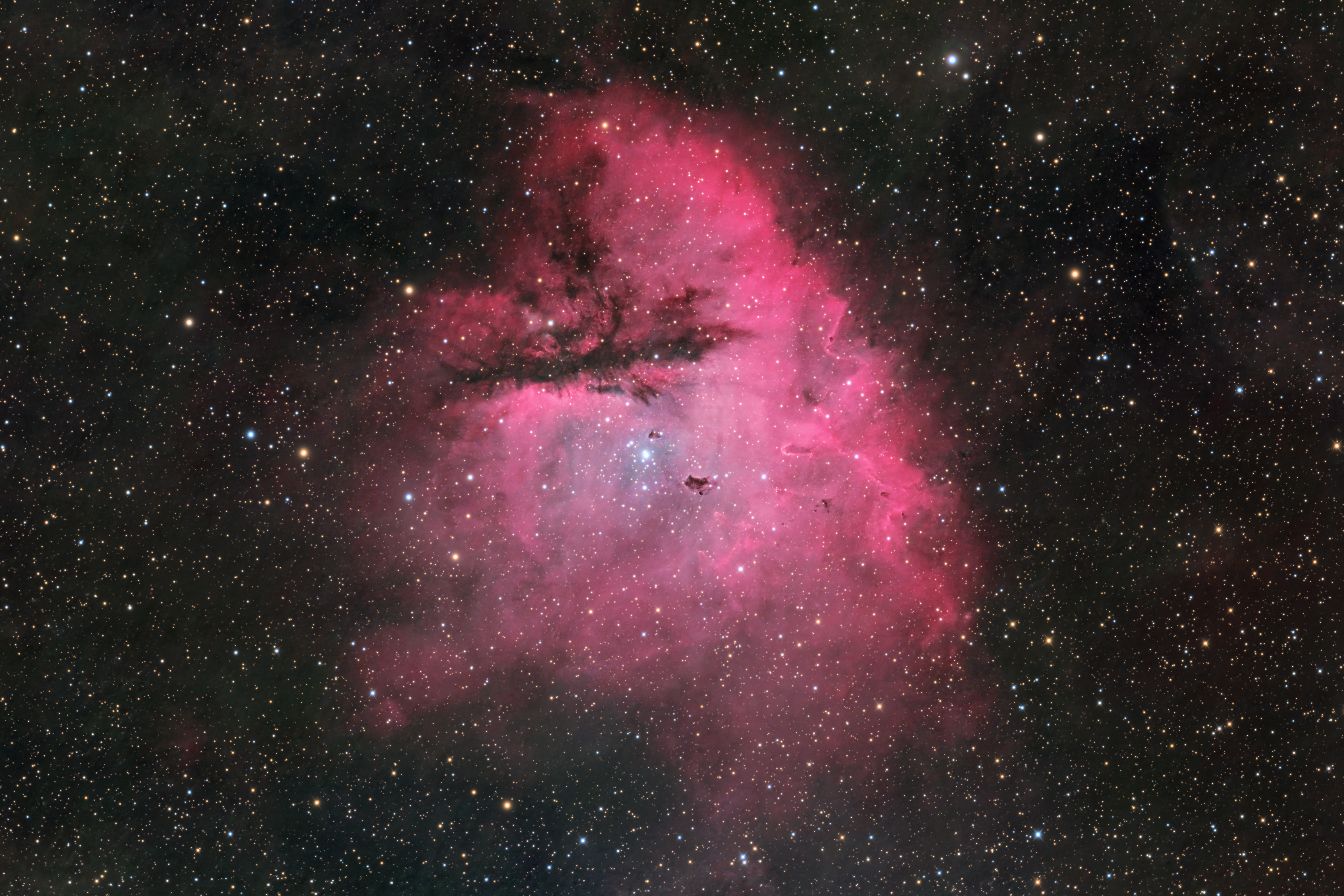
NGC 281 with Celestron Origin
Click images for full size versions
September 7, 2026
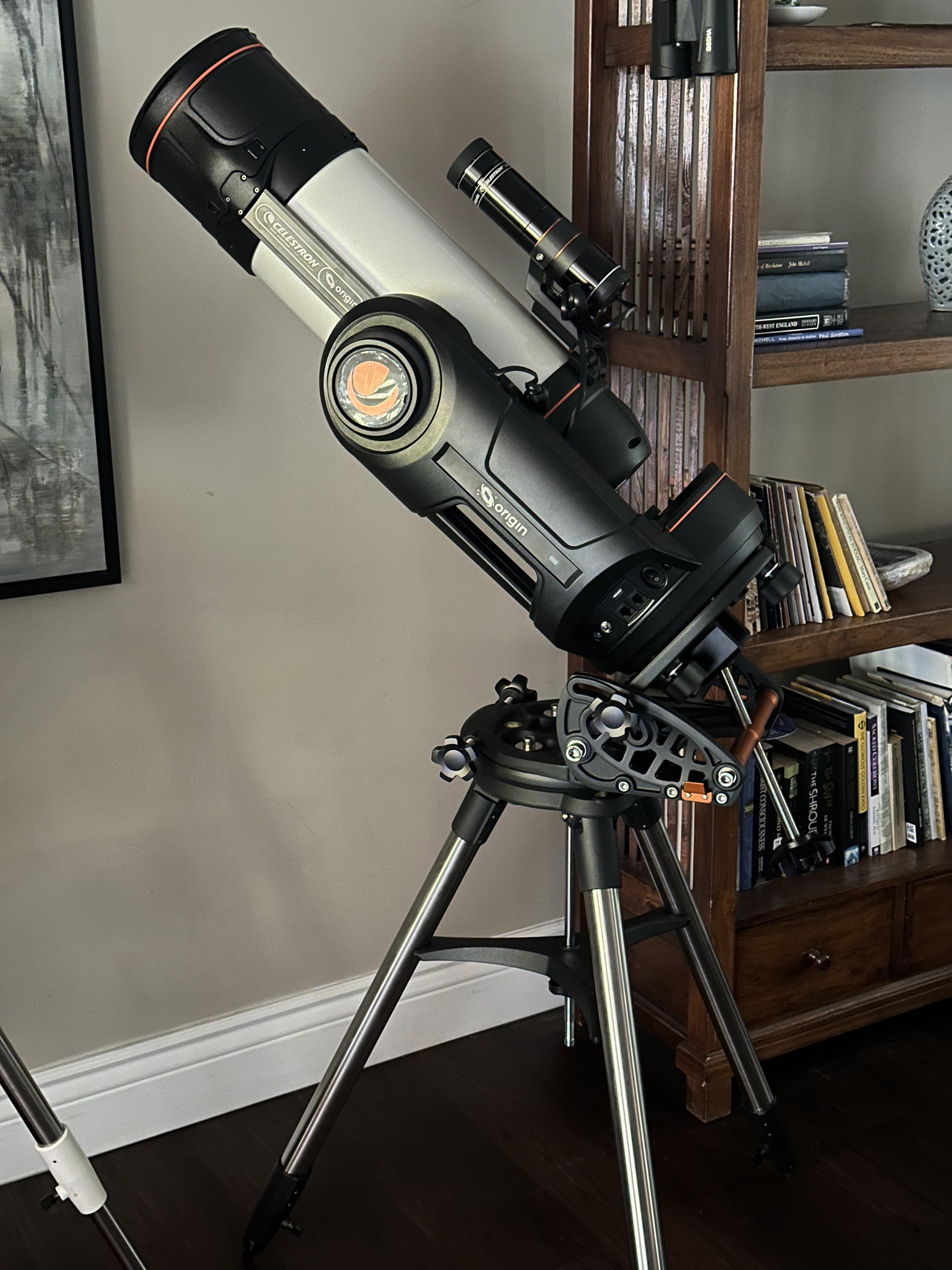 I’m continuing to test the Celestron Origin Mark II ‘Intelligent Home Observatory,’ which Celestron loaned me to use for a while. I had first light with it on August 17, and have used it on the rare clear nights since. I now have it mounted on the matching equatorial wedge and autoguiding with the StarSense autoguider.
Tonight was my first ‘keeper’ long exposure after a night of testing different exposure and ISO settings. I settled on an exposure time of 30s and ISO 1000. I dithered every six frames. Total exposure is 3hr57m.
NGC 281 is also known as the Pacman Nebula. The star cluster in the centre is IC 1590. These cluster stars were born out of this (mainly) hydrogen gas, and now cause it to glow. The black, dense ‘holes’ are called Bok globules, from which the bright stars are born. The Pacman is about 9,500 light years away, and covers a little more sky than the full Moon. I have imaged this object previously (most recently in July 2025), but I like the current version best of all. For you Ha lovers, an Ha only version from 2015 is also available.
Tekkies:
Acquired from my SkyShed in Guelphunder above average transparency and seeing and no Moon on the night of September 6-7, 2026.
474 x 0.5m = 3hr 57m with UV/IR filter.
Preprocessing: The WeightedBatchPreProcessing script was used to perform calibration, cosmetic correction, debayering, weighting, registration, integration and Drizzle integration of all frames (2x drizzle, 0.9 Drop Shrink, Gaussian).
Gradient Removal: DynamicBackgroundExtraction was used to remove gradients.
Colour Calibration: BlurXterminator was applied with Correct Only selected, followed by ColorCalibration.
Deconvolution: BlurXterminator was applied to the RGB master with Automatic psf, star sharpening set to 0.5, and non-stellar set to 0.9.
Stretching: MultiscaleAdaptiveStretch was applied to make a pleasing image with background approximately 0.1.
Nonlinear Processing
Star Removal: StarXterminator was used to remove the stars from the master, with default settings, except Large Overlap was selected. The stars-only image was retained.
Noise Reduction: NoiseXterminator was applied with Amount=0.9 and Iterations = 4
Re-stretch: HistogramTransformation was used to boost contrast by moving the dark point to the toe of the histogram and slightly decreasing the mid-point slider.
Contrast Enhancement: LocalHistogramEqualization was applied three times. A Contrast Limit of 1.5 and 1 iteration was used for each LHE application (scale 40, strength 0.25; scale 150, strength 0.35; scale 500, strength 0.18).
Sharpening: BlurXterminator was used to sharpen the nebula..
Contrast, Brightness and Colour: Brightness, contrast, hue, and saturation were adjusted in several iterations using CurvesTransformation and the Jurgen Terpe Selective Color Correction script, with masks as required.
Stars-only steps: The CIE L* channel (i.e. the lightness channel) was extracted from the stars-only image and then applied to the star image as a mask. CurvesTransformation’s Saturation slider was used to boost colour in the stars.
Star Restoration: The PixelMath expression combine(starless, stars, op_screen()) was used to combine the starless starless image with the stars-only image. The StarReduction script was applied with small star protection enabled (Tranfer method, strength 0.37) to reduce the stars.
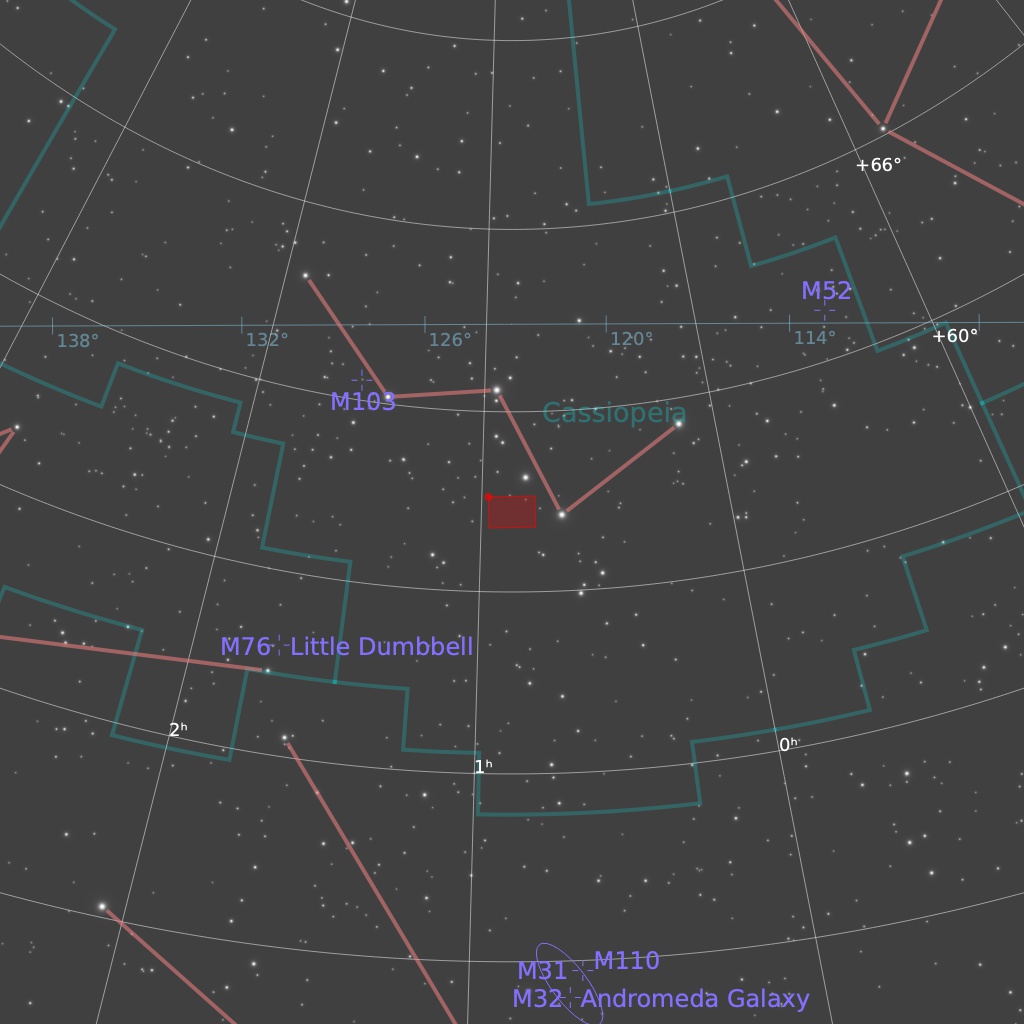
Final Steps: Background, nebula, and star brightness, contrast, and saturation were adjusted in several iterations using CurvesTransformation with masks as required. ICCProfileTransformation (sRGB IEC61966-2.1; Relative Colorimetric with black point compensation) was applied prior to saving as a jpg. The finder chart was made using the FindingChart process.

Leave A Comment