
Soap Bubble Nebula
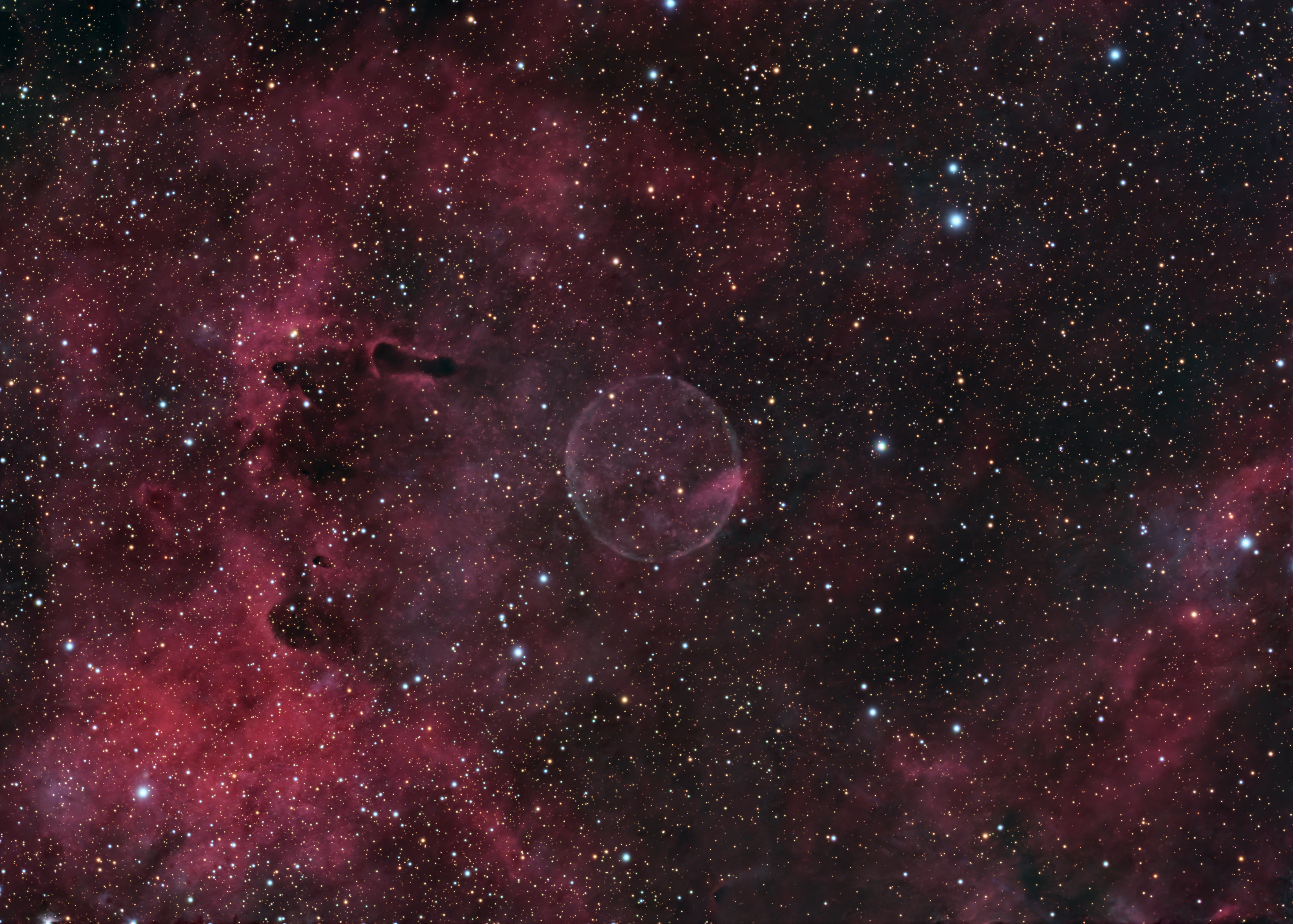 Click image for full size version
July 29, 2026
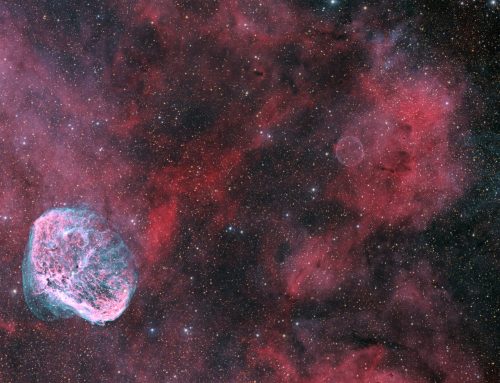
The Soap Bubble Nebula (PN G75.5+1.7) is about 5,000 light years away, near the Crescent Nebula in Cygnus. It is extremely faint, and was discovered in 2007 by amateur astronomer Dave Jurasevich using a 160 mm refractor. This image was taken at much longer focal length (almost 4m) using a 14″- Celestron EDGE HD Schmidt-Cassegrain telescope. The object covers about 1/7 the width of the Moon.
The nebula is practically invisible in colour images unless an H-alpha filter (passing the dominant red emission from excited hydrogen atoms) is used to boost the signal in the red part of the spectrum. This image also include oxygen emissions which are teal-coloured. However, the oxygen is much weaker than the hydrogen and appears mostly in the outer ring of the soap bubble.
Tekkies:
Acquisition, focusing, and control of Paramount MX mount with N.I.N.A., TheSkyX and PHD2. Primalucelab low-profile 2″ Esatto focuser and ARCO rotator. Equipment control with PrimaLuce Labs Eagle 4 Pro. All pre-processing and processing in PixInsight. Acquired from my SkyShed in Guelph. Excellent transparency and above average seeing. Data acquired June 22 to July 12, 2026 under variable moonlight.
Celestron 14″ F/11 EDGE HD telescope at f/11 (3,912 mm focal length) and QHY600M camera binned 2×2 with Optolong filters.
27 x 5m Red = 2hr 15m
19 x 5 m Green = 1hr 35m
16 x 5m Blue = 1hr 20m
91 x 5m Ha = 7hr 35m
73 x 5m O3 =6hr 05m
Total: 18hr 50m
Preprocessing: The WeightedBatchPreProcessing script was used to perform calibration, cosmetic correction, weighting, registration, local normalization integration, and Drizzle integration of all frames.
Colour master: A colour master was made from the Red, Green and Blue masters using ChannelCombination in RGB mode.
Gradient Removal: DynamicBackgroundExtraction was applied to the RGB, Ha and O3 masters.
Colour Calibration: SpectrophotometricColorCalibration was used to calibrate the RGB master.
Deconvolution: BlurXterminator was used on the Ha, O3 and RGB masters with Automatic psf , and star sharpening set to 0.5.
Star Removal and processing: StarXterminator was used to remove the stars, with default settings. Only the RGB stars were retained. HistogramTransformation was used to stretch the stars-only image. Colour was then increased in the stars-only image using the Saturation slider in CurvesTransformation. SCNR was applied to remove a hint of green in the stars-only image.
Addition RGB and Narrowband: The NBRGBCombination script was used to combine Ha and O3 with the RGB to make an HaO3RGB master image for further processing.
Linear Noise Reduction: NoiseXterminator was applied to the starless HaO3RGB image with settings Amount=0.9 and Detail=0.15
Stretching: MultiscaleAdaptiveStretch was applied to the starless HaO3RGB master to make a pleasing image. Approximate background level after stretch was 0.1.
Nonlinear Processing
Nonlinear Noise Reduction: NoiseXterminator was applied to the starless HaO3RGB master with settings Amount=0.9 and Detail=0.2
Re-stretch: HistogramTransformation was used to boost contrast by moving the dark point to the toe of the histogram and slightly decreasing the mid-point slider.
Contrast Enhancement: The CreateHDRImage script was applied (default settings except Intensity and Replace Image checked). LocalHistogramEqualization was then applied twice. A Contrast Limit of 1.5 and 1 iteration was used for each LHE application (scale 150, strength 0.5; scale 60, strength 0.35).
Star Restoration: Stars were added back into the starless HaO3RGB image using the PixelMath expression combine(starless, stars_only, op_screen())
Sharpening: BlurXterminator was applied (no star reduction, no halo reduction, manual psf=3, amount = 0.1). Bill Blanshan and Mike Cranfield’s Star Reduction script was used to slightly shrink brighter stars.
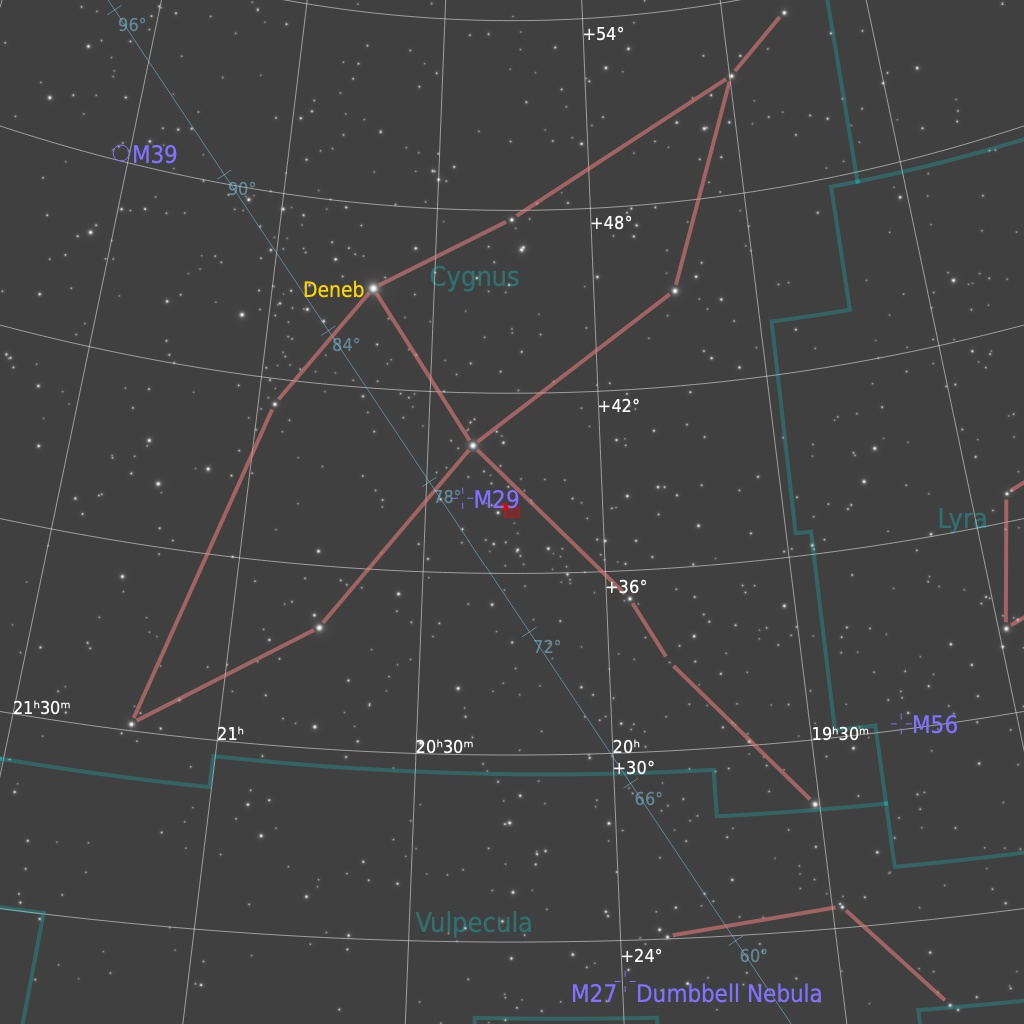
Final Steps: Background, nebula, and star brightness, contrast, and saturation were adjusted in several iterations using CurvesTransformation with masks as required. ICCProfileTransformation (sRGB IEC61966-2.1; Relative Colorimetric with black point compensation) was applied prior to saving as a jpg. The finder chart was made using the FindingChart process.

Leave A Comment