
Coathanger – Gear 90 First Light
 Click image for full size version
August 2, 2026
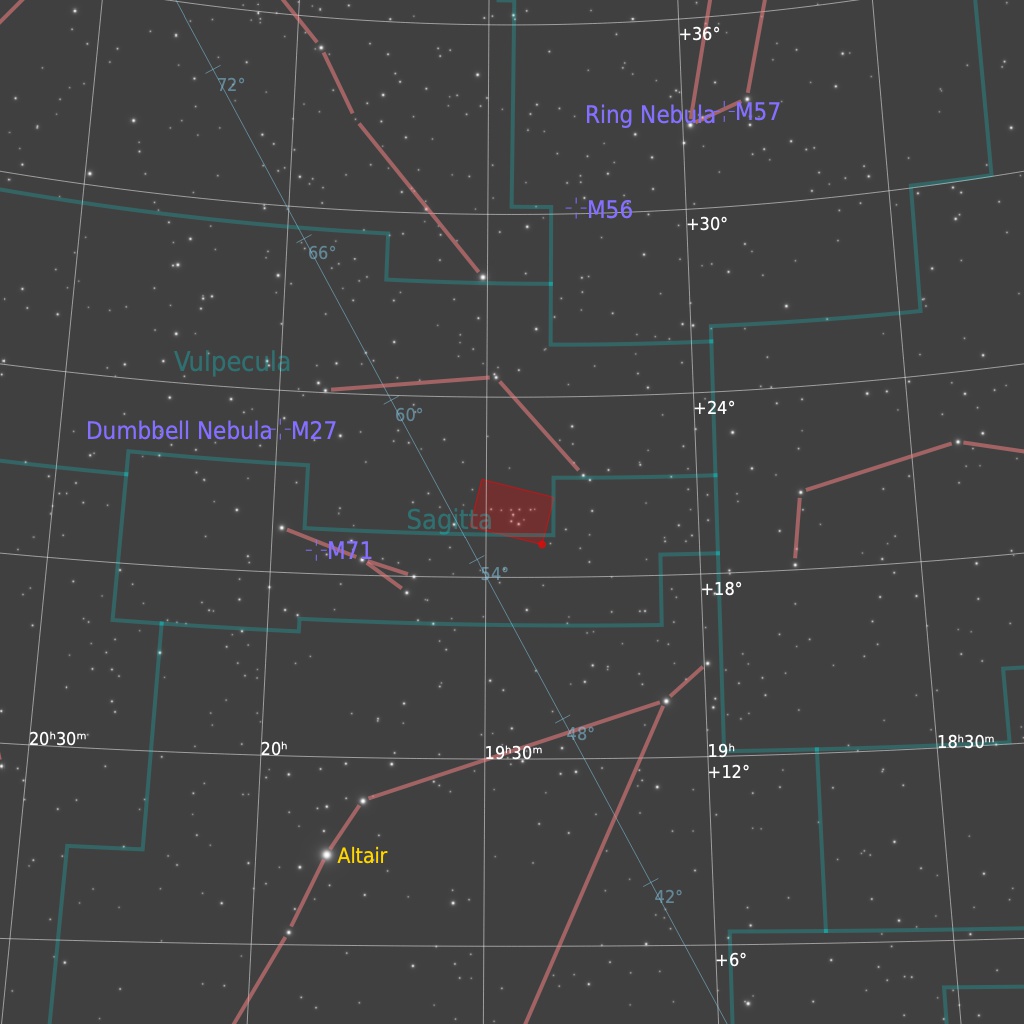
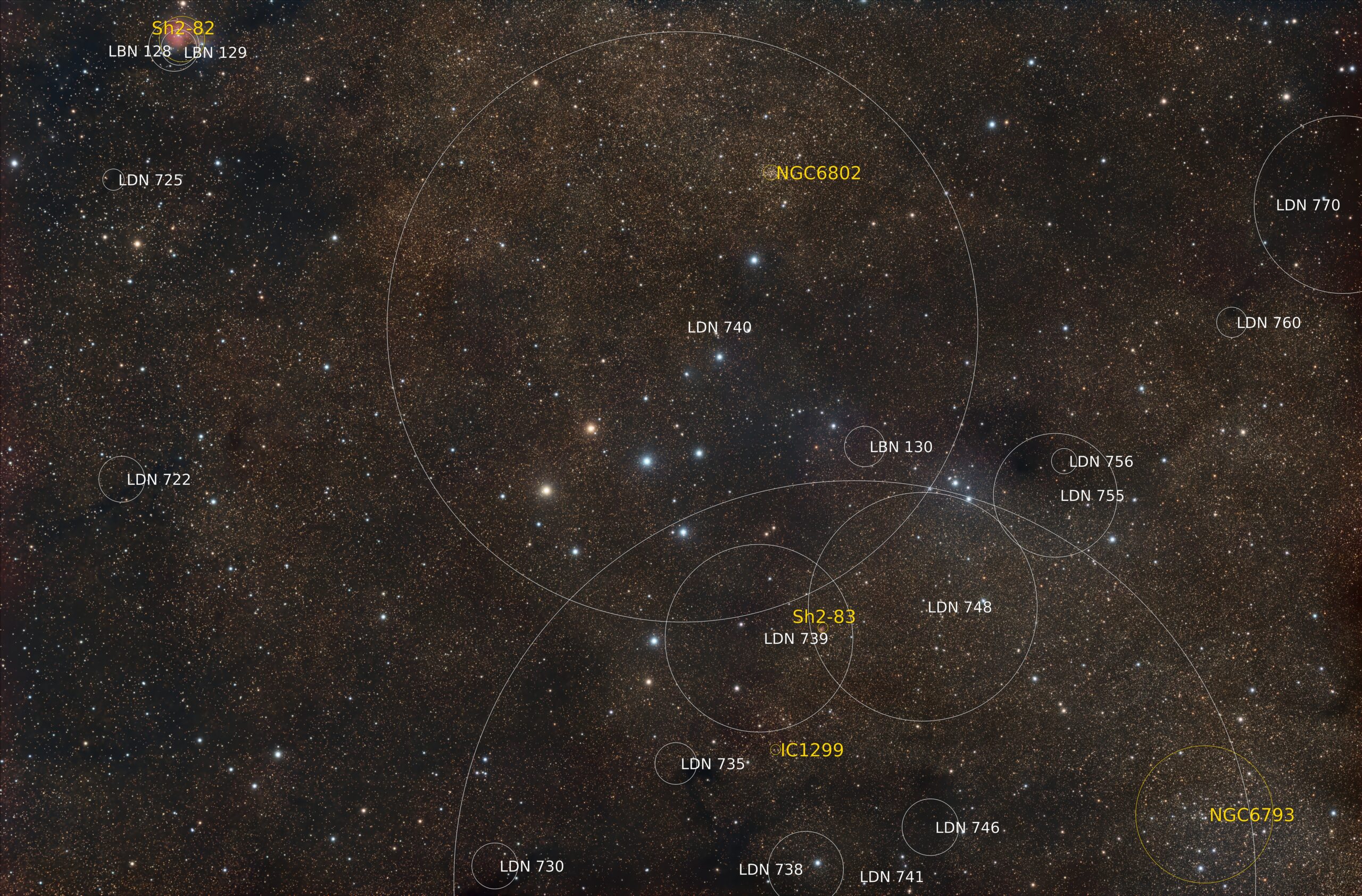
The Coathanger is an asterism — a pattern of stars — that looks unmistakably like its namesake. It is also catalogued as Brocchi’s Cluster and Collinder 399. The Coathanger is located in the constellation of Vulpecula, not far from the tip of Sagitta’s arrow asterism. I’ve looked at this easily located field hundreds of times in binoculars; it is a summer favourite of mine. It can even be seen with the naked eye in a dark sky. The line of six stars (five blue and one gold) covers almost three times the width of the full Moon on the sky.
The Coathanger was long thought to be a star cluster — a group of gravitationally-bound stars. However, it was recently determined that it is a chance alignment of stars. The many dark lanes within the image are part of the Milky Way’s dust lane. I prepared an annotated image that identifies some of the dark features in the image, as well as emission and reflection nebulae. The pretty star cluster near the right edge of the image is NGC 6802. It’s thought to be about 9,000 light years from us.
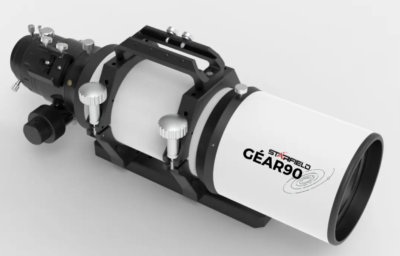
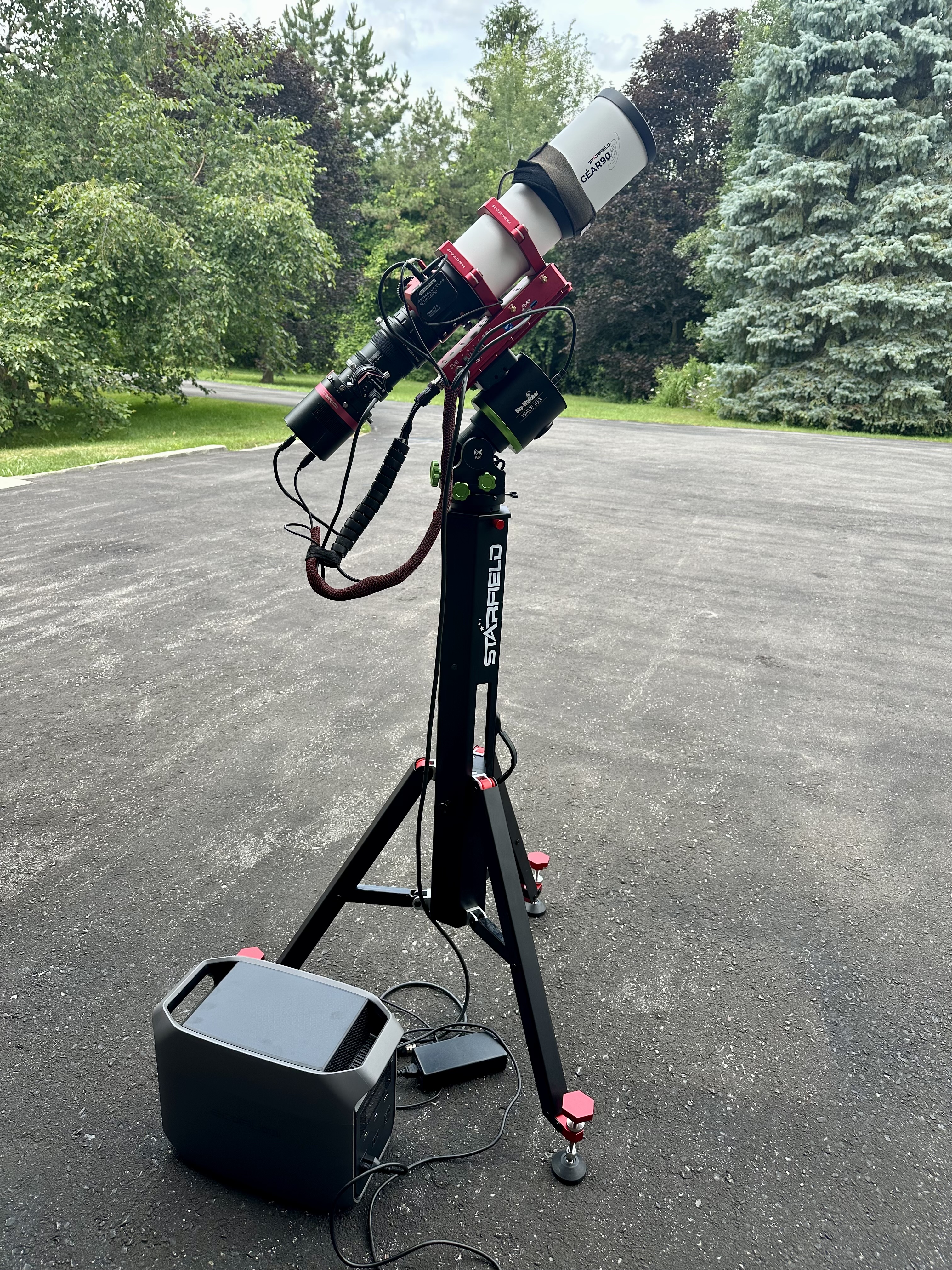
This is the first light image with the Starfield Gear 90 triplet refractor, fitted with a QHY 168C camera and a Primalucelab Sesto Senso 3 robotic focusing motor. It sure worked well! This image was taken on the night of the full Moon, but the stars still punched through the glow. I generally choose a starry field of view for my first light image with any new scope to help me evaluate the performance of the system.
.  .
. 
Tekkies:
Acquisition, focusing, and control of Sky-Watcher Wave 100i mount and other equipment with N.I.N.A., PHD2, and Green Swamp Server. Focus with Primalucelab Sesto Senso 3. Carried on Starfield Tri-Pier 1000B. Equipment control with Primalucelab Eagle 5 Pro computer. All pre-processing and processing in PixInsight. Acquired from my SkyShed in Guelph. Acquired under below average transparency and good seeing under a full Moon on July 30, 2026. There was some haze in the air due to wildfire smoke.
Starfield Gear 90 triplet refractor, QHY168C camera, Optolong UV/IR filter, Player One Sedna-M guide camera, FHD OAG, and filter drawer MAX.
38 x 2m = 1hr 16m
Preprocessing: The WeightedBatchPreProcessing script was used to perform calibration, cosmetic correction, debayering, weighting, registration, integration and Drizzle integration of all frames (2x drizzle, 1.0 Drop Shrink, Gaussian kernel).
Gradient Removal: DynamicBackgroundExtraction was applied to remove gradients due mainly to moonlight.
Colour Calibration: ColorCalibration was applied to the RGB master.
Deconvolution: BlurXterminator was applied to the RGB master with Automatic psf , star sharpening set to 0.5, and non-stellar set to 0.0.
Linear Noise Reduction: NoiseXterminator was applied with settings Amount=0.9 and Iterations=4.
Stretching: HistogramTransformation was applied to make a pleasing image with background approximately 0.1.
Nonlinear Processing
Star Removal: StarXterminator was used to remove the stars from the master, with default settings, except Large Overlap was selected and halos were decreased by 10% (0.1). The stars-only image was retained.
Nonlinear Noise Reduction: NoiseXterminator was applied to the starless image with Amount=0.9 and Iterations = 4. This was followed by a pass of Convolution with default settings except Std Dev = 12.
Re-stretch: HistogramTransformation was used to boost contrast in the starless image by moving the dark point to the toe of the histogram and slightly decreasing the mid-point slider.
Contrast, Brightness and Colour: Brightness, contrast, and saturation were adjusted in several iterations using CurvesTransformation.
Stars-only steps: The CIE L* channel (i.e. the lightness channel) was extracted from the stars-only image and then applied to the star image as a mask. CurvesTransformation’s Saturation slider was used to boost colour in the stars.
Star Restoration: The PixelMath expression combine(starless, stars, op_screen()) was used to combine the starless starless image with the stars-only image.
Final Steps: Background and star brightness and saturation were adjusted in several iterations using CurvesTransformation with masks as required. ICCProfileTransformation (sRGB IEC61966-2.1; Relative Colorimetric with black point compensation) was applied prior to saving as a jpg. The finder chart was made using the FindingChart process. The annotated image was made with the AnnotateImage script.

Leave A Comment