
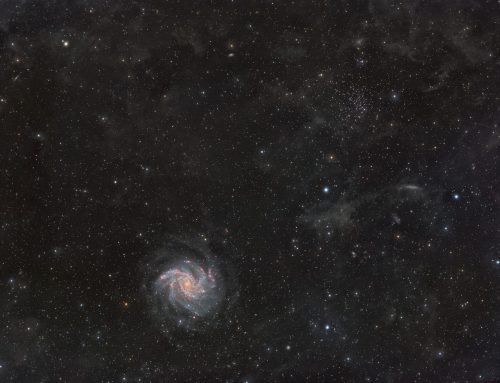
NGC 6946 and NGC 6939 with Celestron Origin
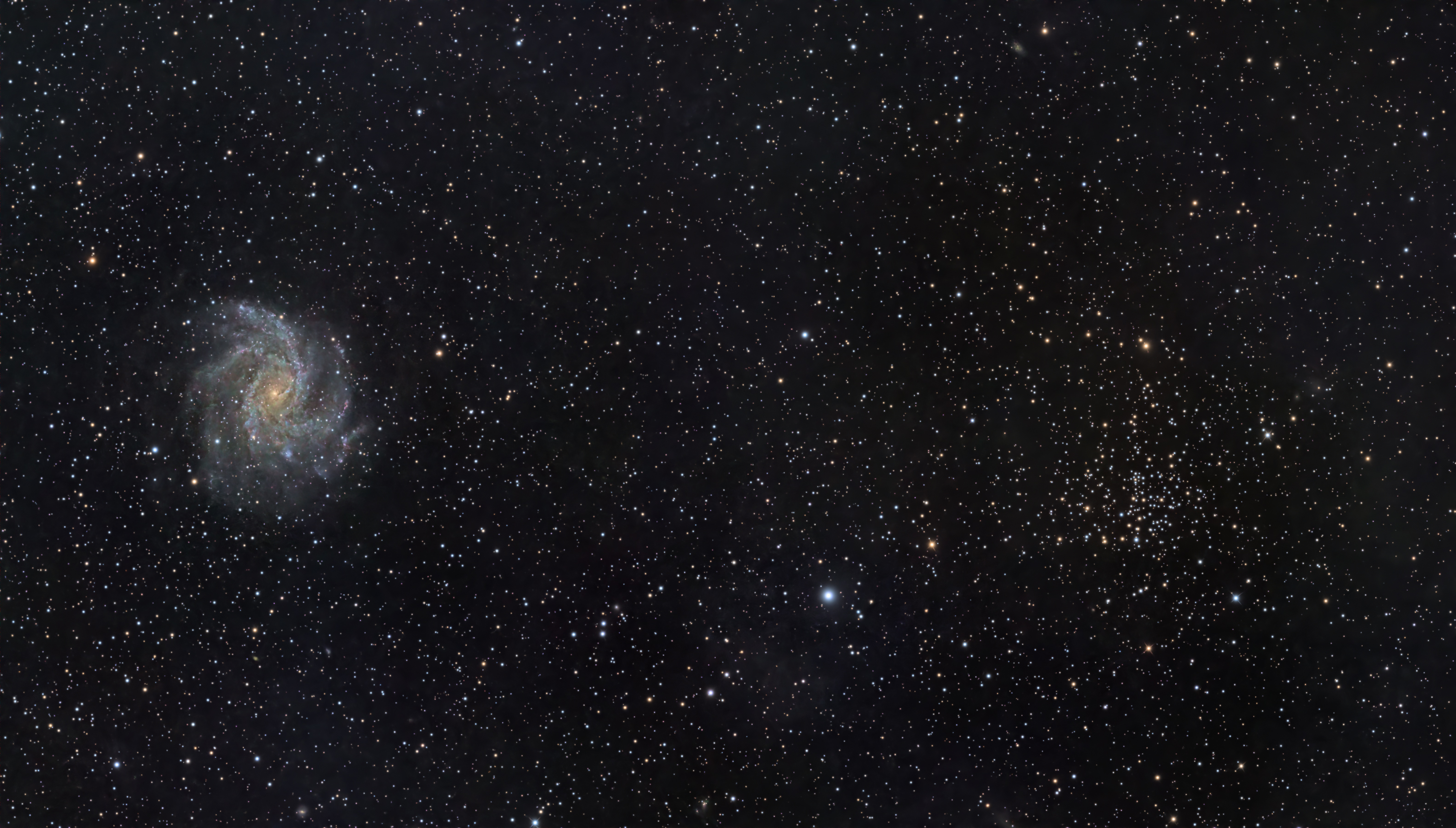
Click images for full size versions
September 2, 2026
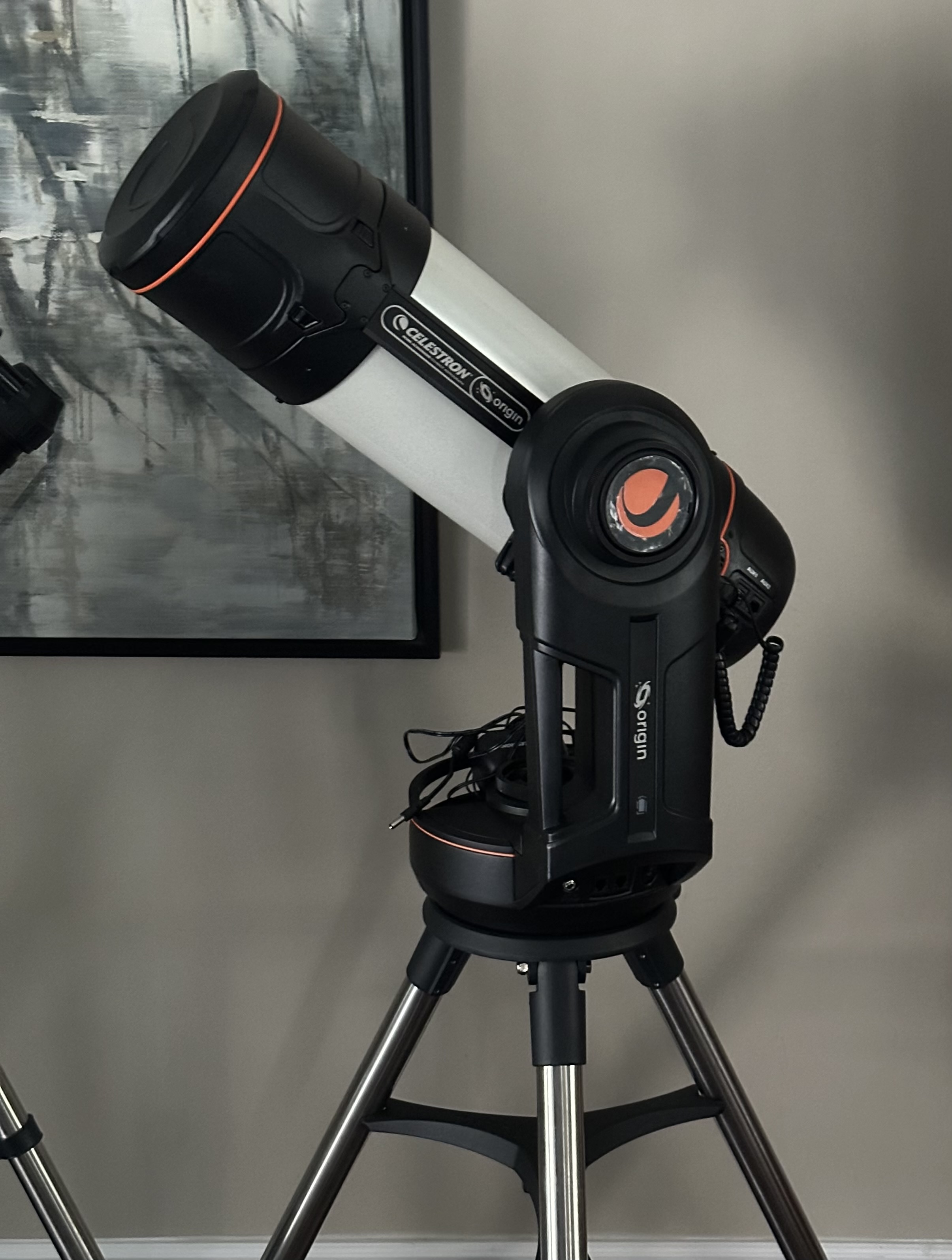 I’m continuing to test the Celestron Origin Mark II ‘Intelligent Home Observatory,’ which Celestron loaned me to use for a while. I had first light with it on August 17, and have used it on the rare clear nights since.
Tonight I was comparing saving individual raw frames vs. Origin stacking them automatically. I compared the stacked image produced automatically by the Origin vs. calibrating and stacking the individual sub-frames amyself in PixInsight. The two approaches produced results that were indistinguishable. However, results with manual stacking and Drizzle processing were considerably better.
I am really looking forward to getting some really long exposure times using the equatorial wedge and autoguider.
To see information about the objects in this image, have a look at my 40+ hour shot using the Esprit 120.
Tekkies:
Acquisition, focusing, and preprocessing by Celestron Origin. 10-second unguided exposures acquired under good transparency and seeing in a moonless sky on Sept 1, 2026. All exposures were 10s. Total exposure times:
193 x 10s = 32m10s, calibrated, aligned and integrated with 2X Drizzle
Image scale: 0.6 arcsec per pixel
Gradient Removal: DynamicBackgroundExtraction was applied to the RGB master.
Colour Calibration: ColorCalibration was applied to the RGB master.
Deconvolution: BlurXterminator was applied to the RGB master with Automatic psf , star sharpening set to 0.5, and non-stellar set to 0.9.
Linear Noise Reduction: NoiseXterminator was applied with settings Amount=0.9 and Iterations=4.
Stretching: MultiscaleAdaptiveStretch was applied to make a pleasing image with background brightness approximately 0.1.
Nonlinear Processing
Noise Reduction: NoiseXterminator was applied to the RGB master with settings Amount=0.9 and Interations=4.
Supplemental Stretch: HistogramTransformation was used to darken the black point and brighten the main galaxy.
Initial Saturation Boost: CurvesTransformation’s saturation tool was used to boost colour in the galaxy in the starless RGB image. A range mask made with RangeSelection was used to protect the background.
Nonlinear Noise Reduction: NoiseXterminator was applied to the RGB image with settings Amount=0.9 and Iterations=5.
Contrast Enhancement: LocalHistogramEqualization was applied twice using a mask to select the main galaxy. Contrast Limit of 1.5 and 1 iteration (scale 150, strength 0.25, and scale 40, strength 0.35).
Sharpening: BlurXterminator was applied (no star reduction, no halo reduction, manual psf=3, amount = 0.1) to the galaxy, using a mask to protect the background.
Star Restoration: Stars were added back into the image using the PixelMath expression combine(starless, stars_only, op_screen())
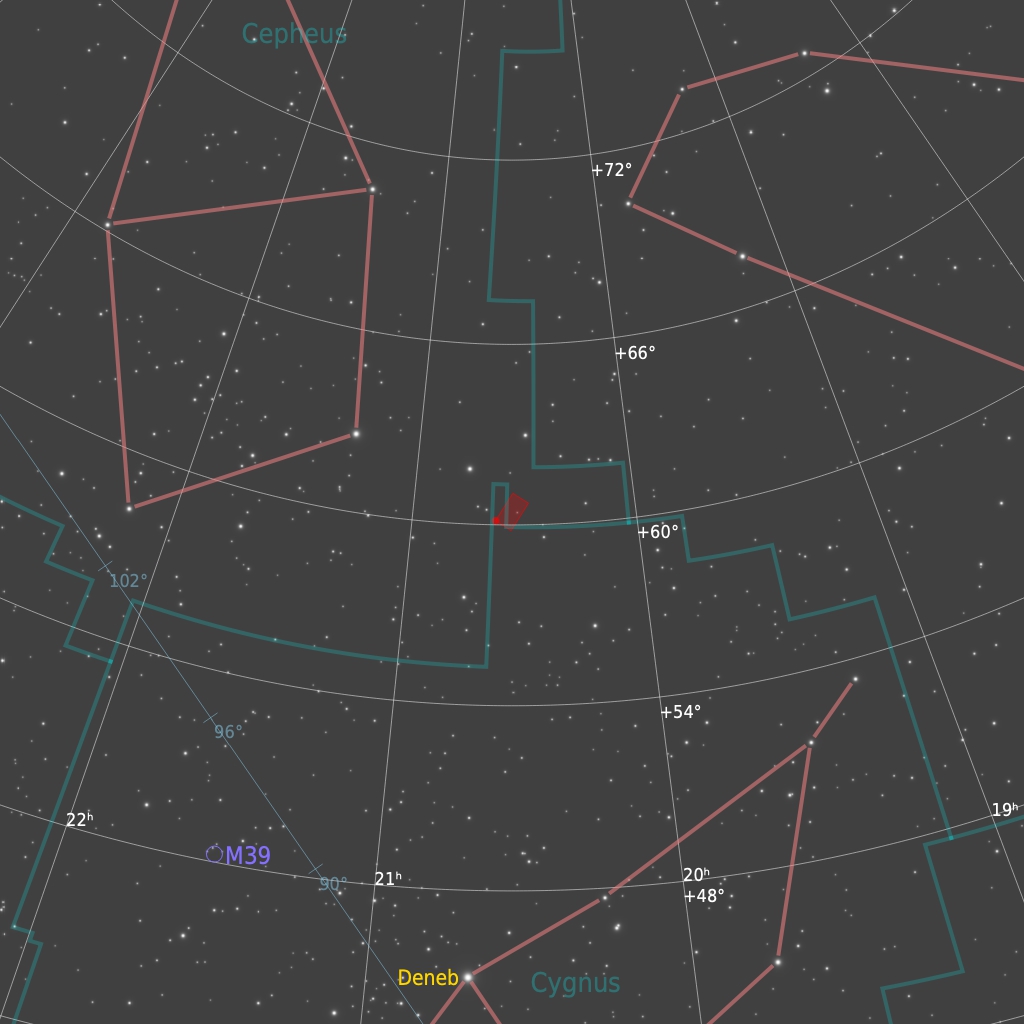
Final Steps: Background, galaxy, and star brightness, contrast, and saturation were adjusted in several iterations using CurvesTransformation with masks as required. Excessive star haloes were dimmed slightly with CloneStamp. ICCProfileTransformation (sRGB IEC61966-2.1; Relative Colorimetric with black point compensation) was applied prior to saving as a jpg. The finder chart was made using the FindingChart process. The annotated image was made with the AnnotateImage script.

Leave A Comment