
Sh2-112 in Narrowband
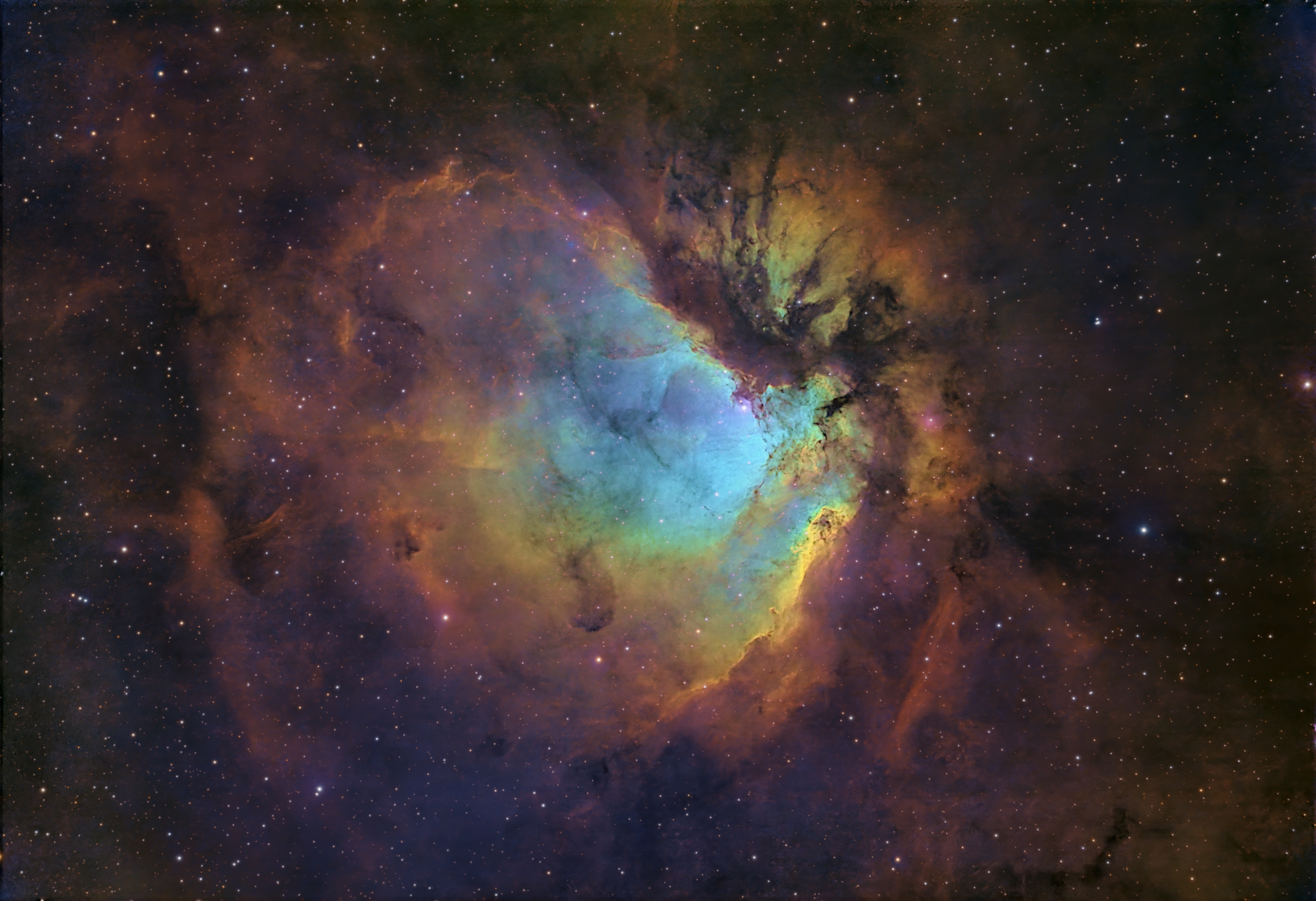 Click image for full size version
July 1, 2026
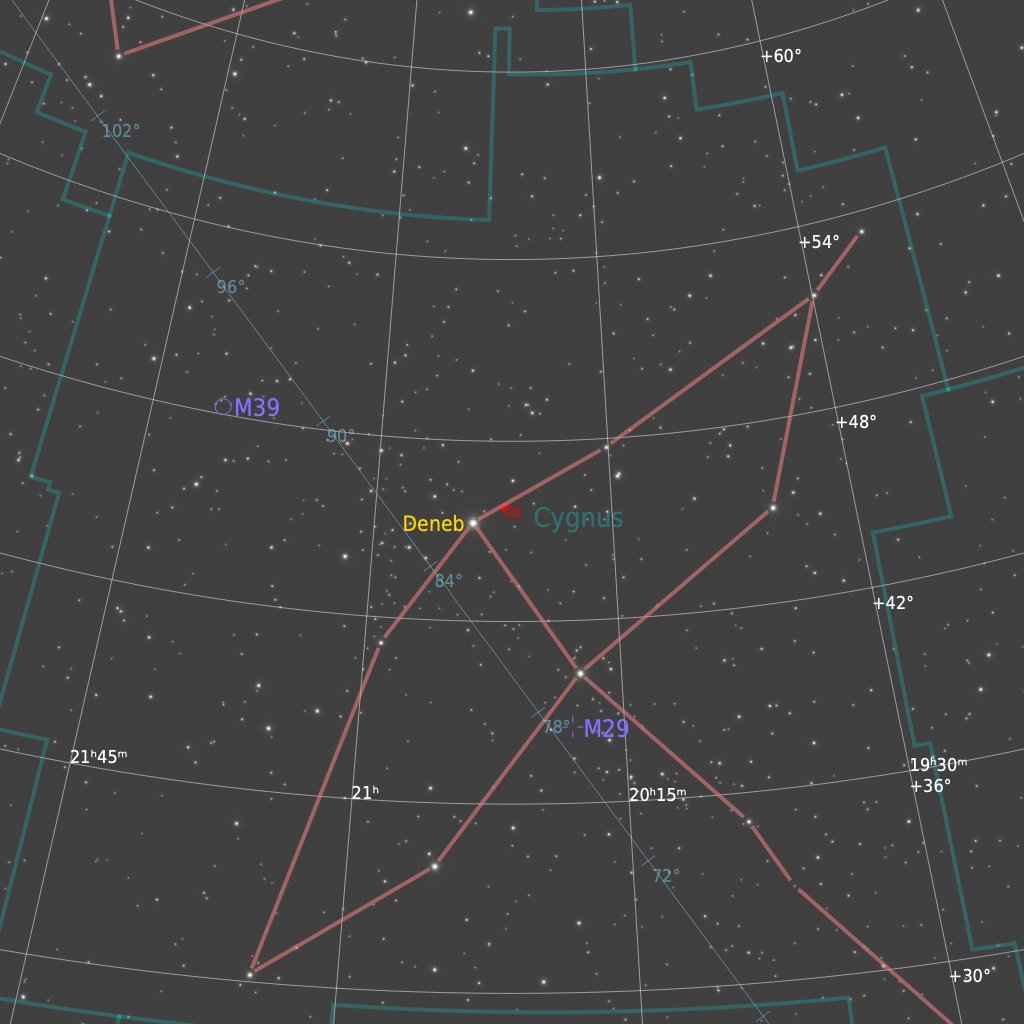
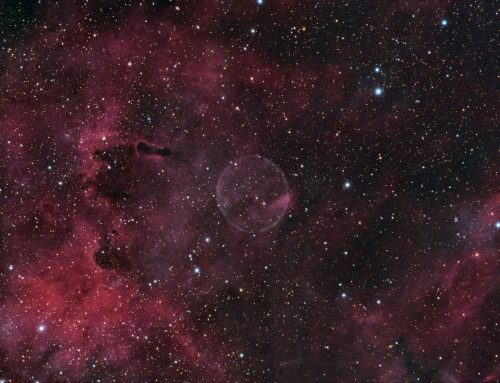
Sh2-112 lies about 5.600 light years from Earth in Cygnus, the Swan It’s not far from the North America Nebula, but twice as far away. This whole area of Cygnus is dominated by the Milky Way and is awash in faint nebulosity, as can be seen in this image. The nebula is illuminated by the bright star BD+45 3216, at its centre, which is about 30x the size of the Sun. It is about 50 light years across, and the main nebula covers about half the width of the Moon on the sky.
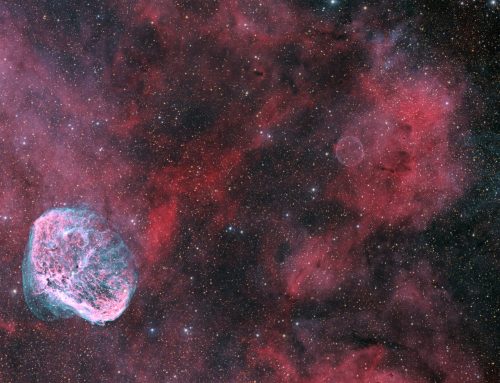
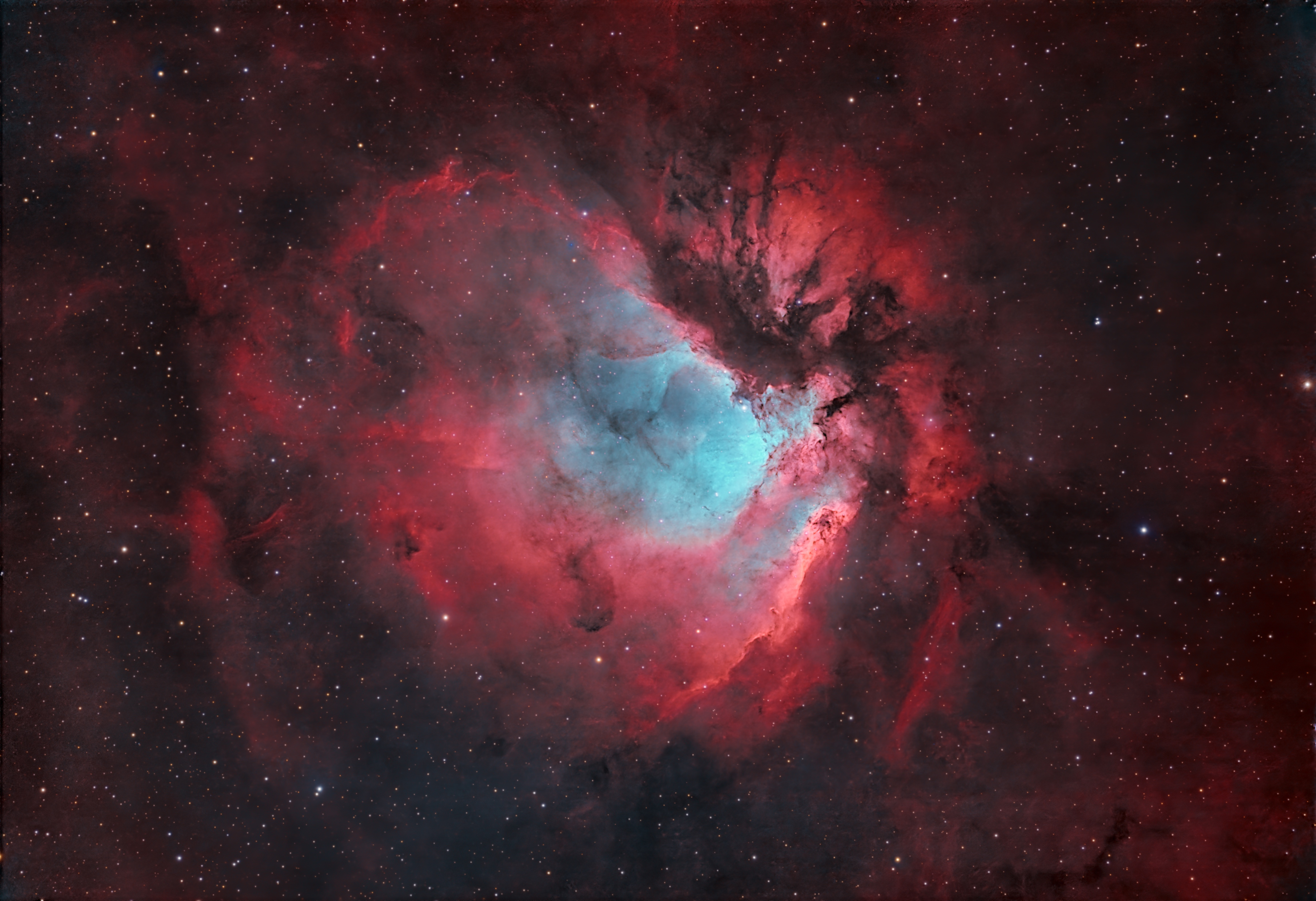 In addition to the image above, I created a very different-looking version by assigning hydrogen and sulfur to red, and oxygen to both green and blue. Click the pic at left to see the full-res version.
This nebula does not seem to be a particularly popular imaging target, though I am not sure why. It is quite beautiful. I imaged it many years ago in broadband. I will need to return to this again soon.
Tekkies:
Acquisition, focusing, and control of Paramount MX mount with N.I.N.A., TheSkyX. Guiding with PHD2. Primalucelab low-profile 2″ Essato focuser, ARCO rotator and Giotto flat panel. Equipment control with PrimaLuce Labs Eagle 4 Pro computer. All pre-processing and processing in PixInsight. Acquired from my SkyShed in Guelph. Below average transparency and seeing. Acquired under a strongly moonlit sky from May 31 – June 7, 2026.
Celestron 14″ EDGE HD telescope at f/11 (3,931 mm focal length) and QHY600M-SBFL camera binned 2×2 with Optolong filters.
98 x 5m S2 = 8hr 10m
99 x 5m Ha = 8hr 15m
96 x 5m O3 = 8hr 00m
Total: 24hr 25m
Preprocessing: The WeightedBatchPreProcessing script was used to perform calibration, cosmetic correction, weighting, registration, local normalization, integration, drizzle integration (x1), and auto-cropping.
Colour master: A Hubble palette master was made with Channel Combination assigning the Sulfur, Hydrogen and Oxygen masters to the red, greem, and blue channels, respectively.
SynthL master: A synthetic lightness channel was created with ImageIntegration, weighting the three masters by quality.
Gradient Removal: DynamicBackgroundExtraction was applied to both masters.
Colour Calibration: Background neutralization was applied to the SHO master, followed by ColorCalibration to equalize the colour channels (not to calibrate colour as one would a natural-colour broadband image).
Deconvolution: BlurXterminator was applied to the SHO and SynthL images with Automatic psf at default settings.
Stretching: MultiscaleAdaptive Stretch was applied to the SHO and SynthL images. Approximate background level after the stretches was 0.10 for the SynthL and 0.09 for the SHO.
Nonlinear Processing
Star Removal: StarXterminator was used to remove the stars from both SHO and SynthL, with default settings. Only the SHO stars were retained.
SynthL and SHO Combination: The SynthL image was used to replace the L* channel of the SHO image using LRGBCombination.
Nonlinear Noise Reduction: NoiseXterminator was applied to the starless SHO image with settings Amount=0.9 and Iterations = 3
Contrast Enhancement: LocalHistogramEqualization was applied three times to the SHO image. A Contrast Limit of 1.5 and 1 iteration was used for each LHE application (scale 450, strength 0.10; 150, strength 0.35; scale 50, strength 0.22).
Sharpening: A mask was used to select brighter regions of the SHO image for sharpening with BlurXterminator (no star or halo adjustment; manual PSF = 3.1, Amount = 0.15.
Narrowband Channel Extraction: In preparation for making an additional image, the red, green, and blue colour channels were extracted from the Hubble palette master. They were renamed S, H, and O, respectively.
(H+S)OO Image Creation: An HOO master was created with the extracted channels, and the background neutralized by slightly adjusting individual channels in HistogramTransformation. Jurgen Terpe’s CombineHaWithRGBscript was then used to add S to the red channel.
Star Processing and Restoration: The strong magenta hue of the stars was reduced by Inverting the image, applying SCNR, and inverting the image a second time. CurvesTransformation’s Saturation slider was used through a star mask to boost saturation. The stars were added back into the two master images using the PixelMath expression combine(starless, stars, op_screen()).
Final Steps: Background, nebula and star brightness, contrast and saturation were adjusted using several iterations of CurvesTransformation, with masks, as required. ICCProfileTransformation (sRGB IEC61966-2.1; Relative Colorimetric with black point compensation) was applied prior to saving as a jpg.

Leave A Comment