
Abell 1656 – The Coma Galaxy Cluster
 Click image for full size version
June 10, 2026
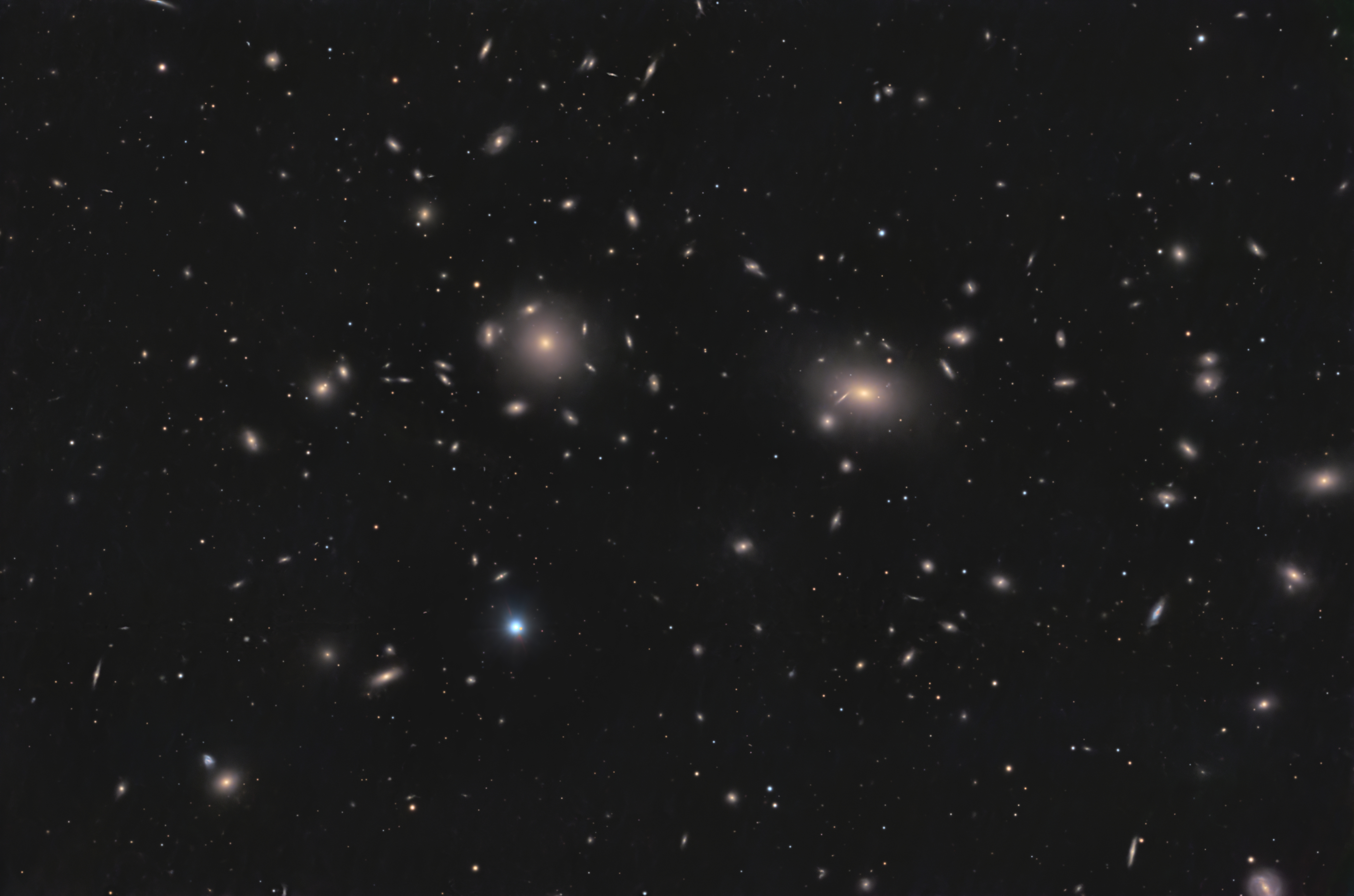
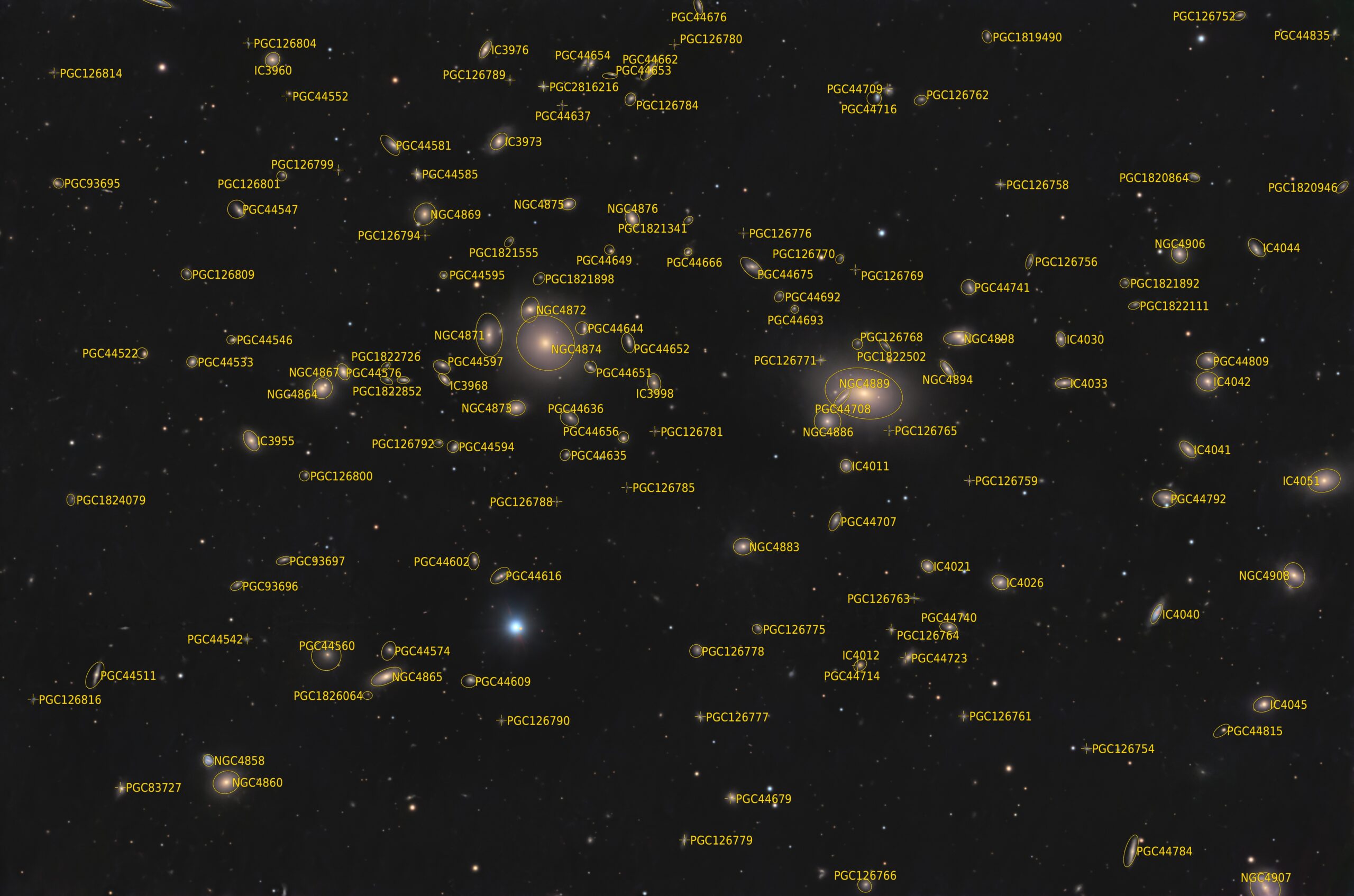
Abell 1656 is better known as the Coma Galaxy Cluster. It lies in Coma Berenices and contains at least 1,000 galaxies with an average distance of 321 million years. The two large galaxies in the centre are NGC 4874 (left) and NGC 4889. Both are supergiant elliptical galaxies. The Coma Cluster is one of the nearest large galaxy clusters, and has an estimated total mass of 5 × 10¹⁵ solar masses (that’s 1,000,000,000,000,000 times the mass of the Sun). It is just staggering to me that all these galaxies reside in this patch of sky the size of a half Moon, and each one contains hundreds of millions or even billions of stars.
I’ve prepared an annotated version of the image above. NGC, IC and PGC galaxies are marked and labelled. However, there are many more unlabelled galaxies that aren’t in these often-referenced galaxy catalogues. Anything fuzzy in this image is a galaxy. The stars are sharp, round, and mostly tiny.
Tekkies:
Acquisition, focusing, and control of Paramount MX mount with N.I.N.A., TheSkyX. No guiding. Primalucelab low-profile 2″ Essato focuser, ARCO rotator and Giotto flat panel. Equipment control with PrimaLuce Labs Eagle 4 Pro computer. All pre-processing and processing in PixInsight. Acquired from my SkyShed in Guelph. Average transparency and average or better seeing. Acquired under variable moon illumination from May 21 – 31, 2026.
Celestron 14″ EDGE HD telescope at f/11 (3,931 mm focal length) and QHY600M-SBFL camera binned 2×2 with Optolong filters.
225 x 1m Red = 3hr 45m
220 x 1m Green = 3hr 40m
215 x 1m Blue = 3hr35m
Total: 11hr 00m
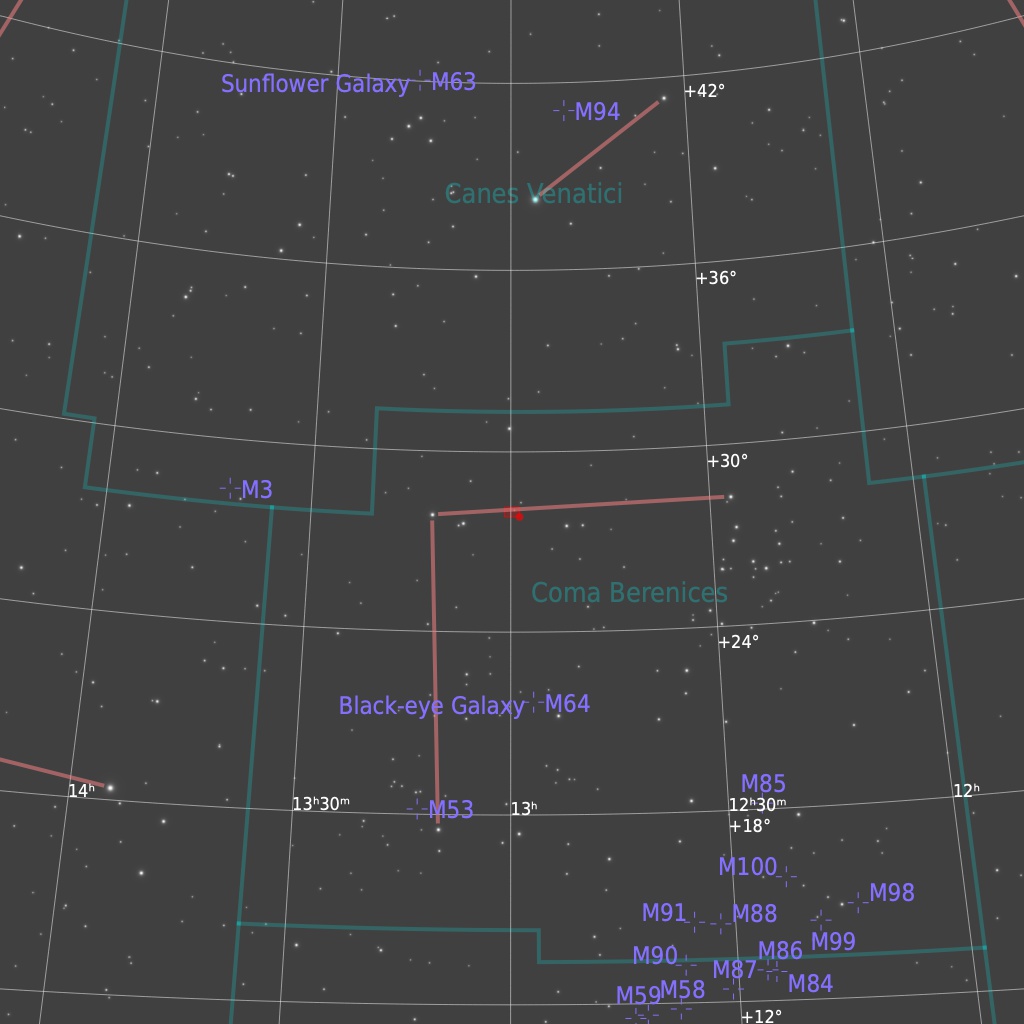 .
. 
Preprocessing: The WeightedBatchPreProcessing script was used to perform calibration, cosmetic correction, weighting, registration, integration, and drizzle integration.
RGB and SynthL masters: A master RGB image was made from the Red, Green and Blue Drizzled masters using ChannelCombination in RGB mode. A synthetic luminance (SynthL) master was made from all four masters using ImageIntegration with weighting by SNR.
Gradient Removal: DynamicBackgroundExtraction was applied to the SynthL, RGB and Ha masters.
Colour Calibration: BlurXterminator was applied to the RGB master with Correct Only selected, followed by SpectrophotometricColorCalibration.
Deconvolution: BlurXterminator was applied to the RGB, SynthL, and Ha masters with Automatic psf, star sharpening set to 0.5, and non-stellar set to 0.9.
Stretching: MultiscaleAdaptiveStretch was applied to make a pleasing image from the RGB and SynthL masters. Approximate background level after stretch was 0.09 for the RGB master and 0.1 for the SynthL master.
Nonlinear Processing
SynthL and RGB Combination: LRGBCombination was used to replace the CIE L* channel of the RGB image with the SynthL
Star Removal and processing: StarXterminator was used to remove the stars from the SynthLRGB master with Unscreen checked. Colour was increased in the stars-only image by increasing saturation using CurvesTransformation through a star mask. The bright blue star was reduced in size and intentsity.
Nonlinear Noise Reduction: NoiseXterminator was applied to the SynthLRGB image with settings Amount=0.9 and Iterations=5.
Contrast Enhancement: LocalHistogramEqualization was then applied twice. A Contrast Limit of 1.5 and 1 iteration was used for each application (scale 150, strength 0.18 and scale 40, strength 0.18).
Star Restoration: Stars were added back into the image using the PixelMath expression combine(starless, stars_only, op_screen())
Final Steps: Background, galaxy, and star brightness, contrast, and saturation were adjusted in several iterations using CurvesTransformation and Jurgen Terpe’s SelectiveColorCorrection script with masks as required. A dark horizontal artifact from the bright blue star was repaired with the CloneStamp tool. ICCProfileTransformation (sRGB IEC61966-2.1; Relative Colorimetric with black point compensation) was applied prior to saving as a jpg. The finder chart was made using the FindingChart process. The annotated image was made with the AnnotateImage script.

Leave A Comment