
B150
 Click image for full size version
January 26, 2026
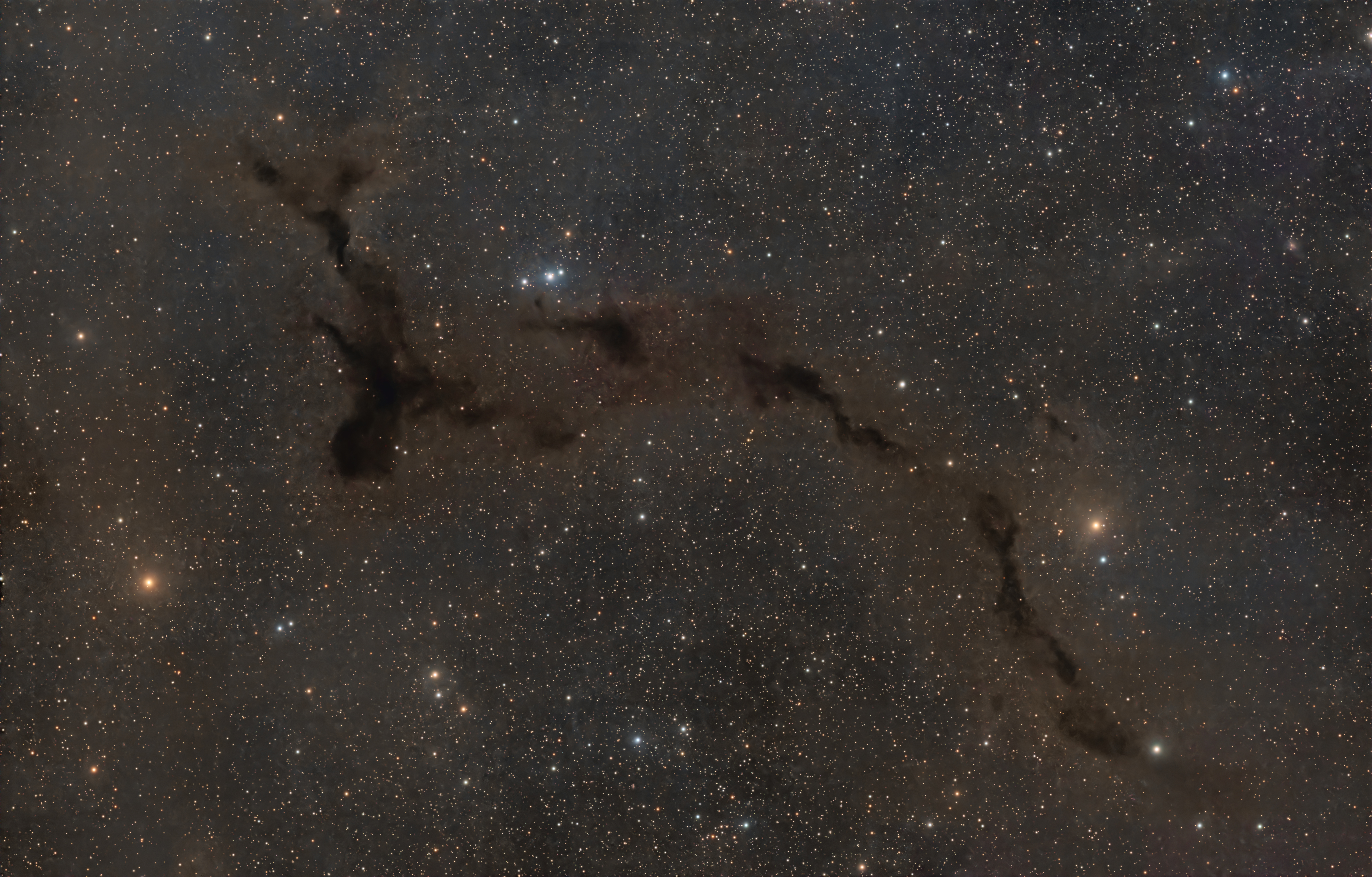
Barnard 150 (B150) is a dark nebula in the constellation Cepheus. It is about one degree long (about two Moon widths). It’s sometimes referred to as the Seahorse nebula. It is made up of soot and dust within our galaxy. It appears dark because it is blocking out the light of stars behind it. The rich star field in which this object is set displays stars of many hues, which depend on their temperatures (blue and white are hotter; yellow and reddish are cooler).
Tekkies:
Acquisition, focusing, and control of Sky-Watcher Wave 150i mount and other equipment with N.I.N.A. and Green Swamp Server. Primalucelab 3″ ESATTO focuser, ARCO rotator, GIOTTO flat panel and ALTO cover motor. Equipment control with Primalucelab EAGLE 6 Pro computer. All pre-processing and processing in PixInsight. Acquired from my SkyShed in Guelph. Acquired under above average transparency and seeing and no Moon from July 28 – August 2, 2025.
Includes first light with Sky-Watcher Esprit 120 refractor. QHY168C camera with Optolong L-Quad Enhance filter.
84 x 5m = 7hr 00m
Preprocessing: The WeightedBatchPreProcessing script was used to perform calibration, cosmetic correction, debayering, weighting, registration, integration and Drizzle integration of all frames (2x drizzle, 1.0 Drop Shrink).
Gradient Removal: DBE was applied to remove gradients and neutralize the background.
Colour Calibration: BlurXterminator was applied to the RGB master with Correct Only selected, followed by ColorCalibration.
Deconvolution: BlurXterminator was applied to the RGB master with Automatic psf , star sharpening set to 0.5, and non-stellar set to 0.90
Linear Noise Reduction: NoiseXterminator was applied with settings Amount=0.9 and Iterations=4.
Stretching: MultiscaleAdaptiveStretch was applied to make a pleasing image.
Star Removal and processing: StarXterminator was used to remove the stars from the master image with Unscreen checked. Colour was increased in the stars-only image by applying Curves saturation through a star mask.
Nonlinear Processing
Nonlinear Noise Reduction: NoiseXterminator was applied with Amount=0.9 and Iterations = 4. SCNR was applied with default settings except Amount = 0.5.
Re-stretch: HistogramTransformation was used to boost contrast by moving the dark point to the toe of the histogram and slightly decreasing the mid-point slider.
Contrast Enhancement: LocalHistogramEqualization was then applied twice. A Contrast Limit of 1.5 and 1 iteration was used for each application (scale 40, strength 0.2, and scale 150, strength 0.25).
Star Restoration: Stars were added back into the image using the PixelMath expression combine(starless, stars_only, op_screen())
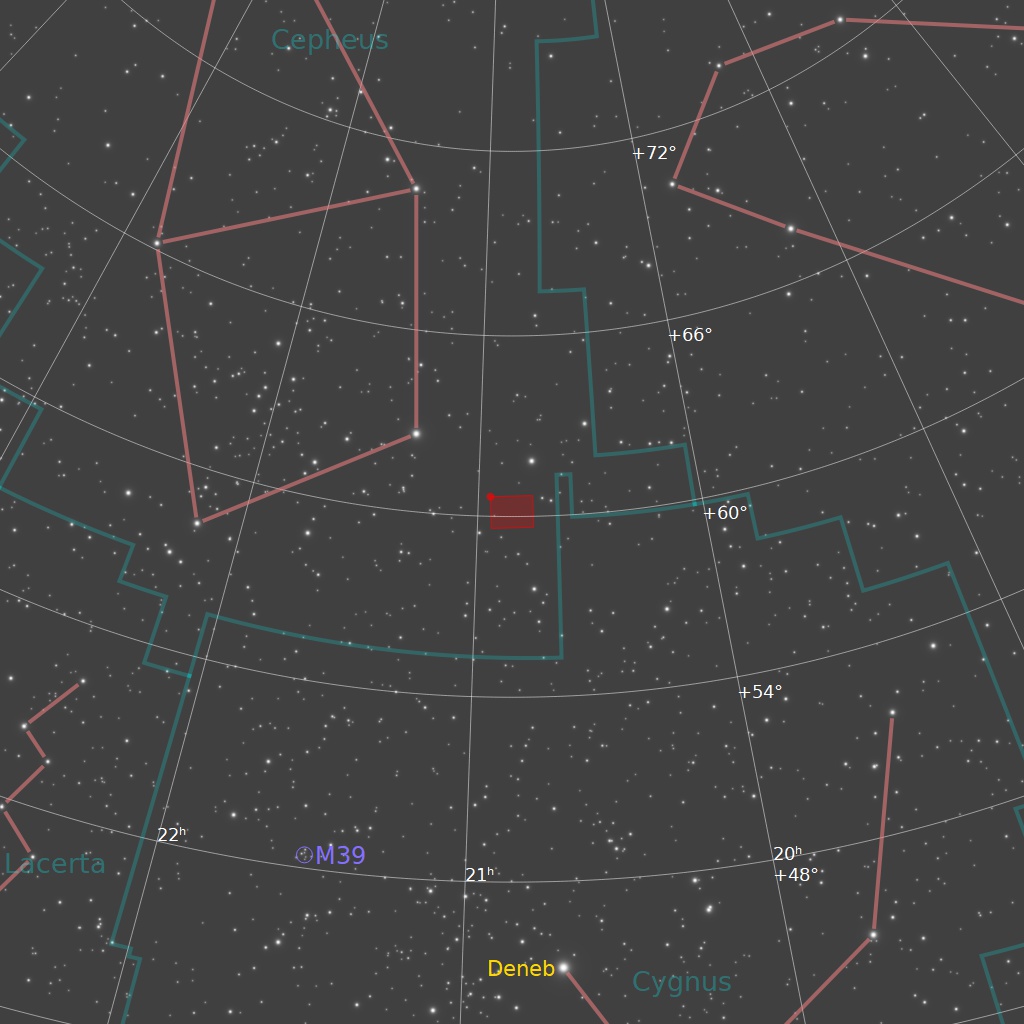
Final Steps: Background, and star brightness, contrast, and saturation were adjusted in several iterations using CurvesTransformation with masks as required. ICCProfileTransformation (sRGB IEC61966-2.1; Relative Colorimetric with black point compensation) was applied prior to saving as a jpg. The finder chart was made using the FindingChart process.

Hi Ron,
You are so out of our league I’m really proud of you buddy ! Keep the dedication…
Gerry
Nice!
Fantastic image, amazing star colours.