
Cas A Supernova Remnant
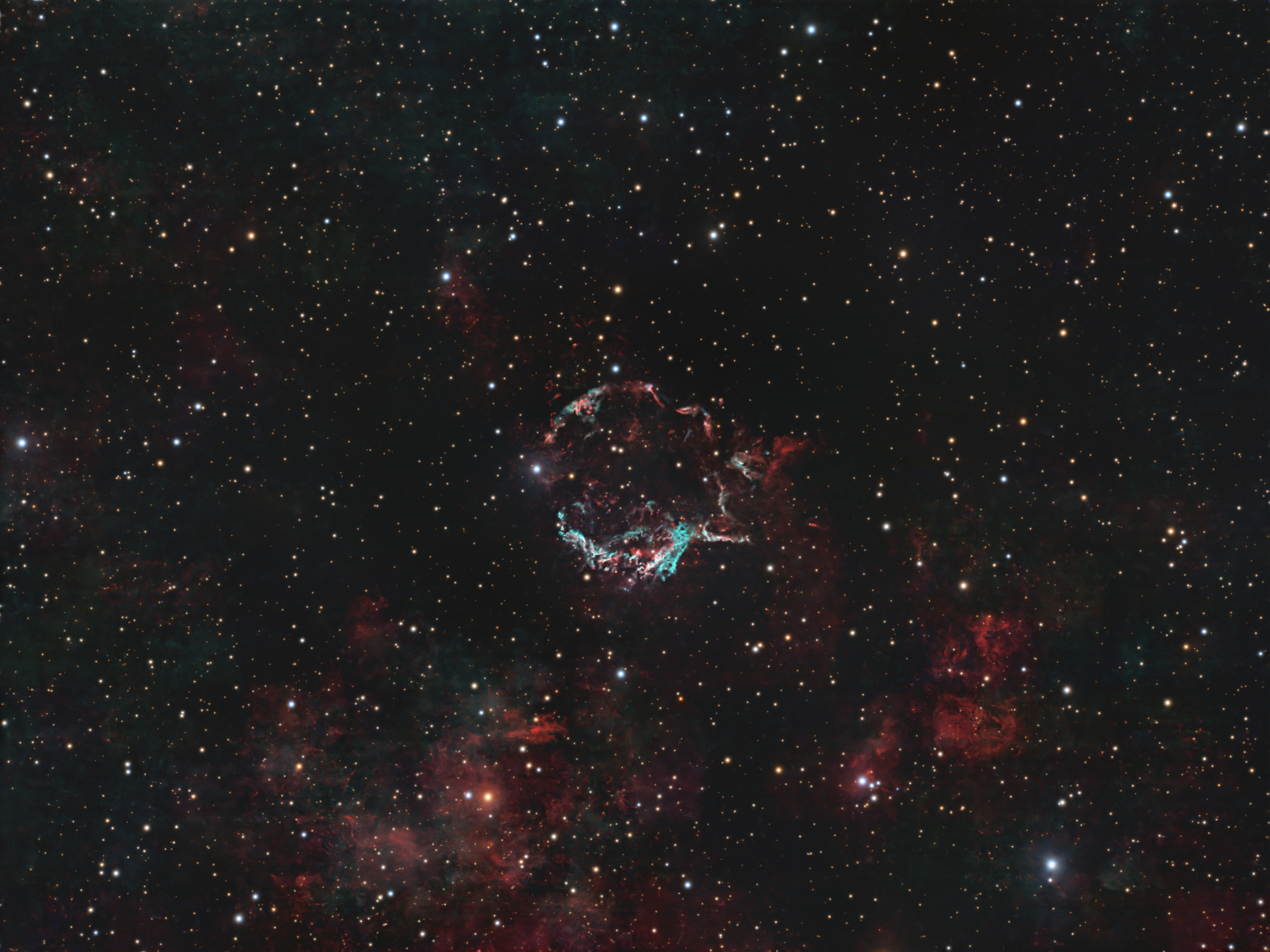 Click image for full size version
February 3, 2026
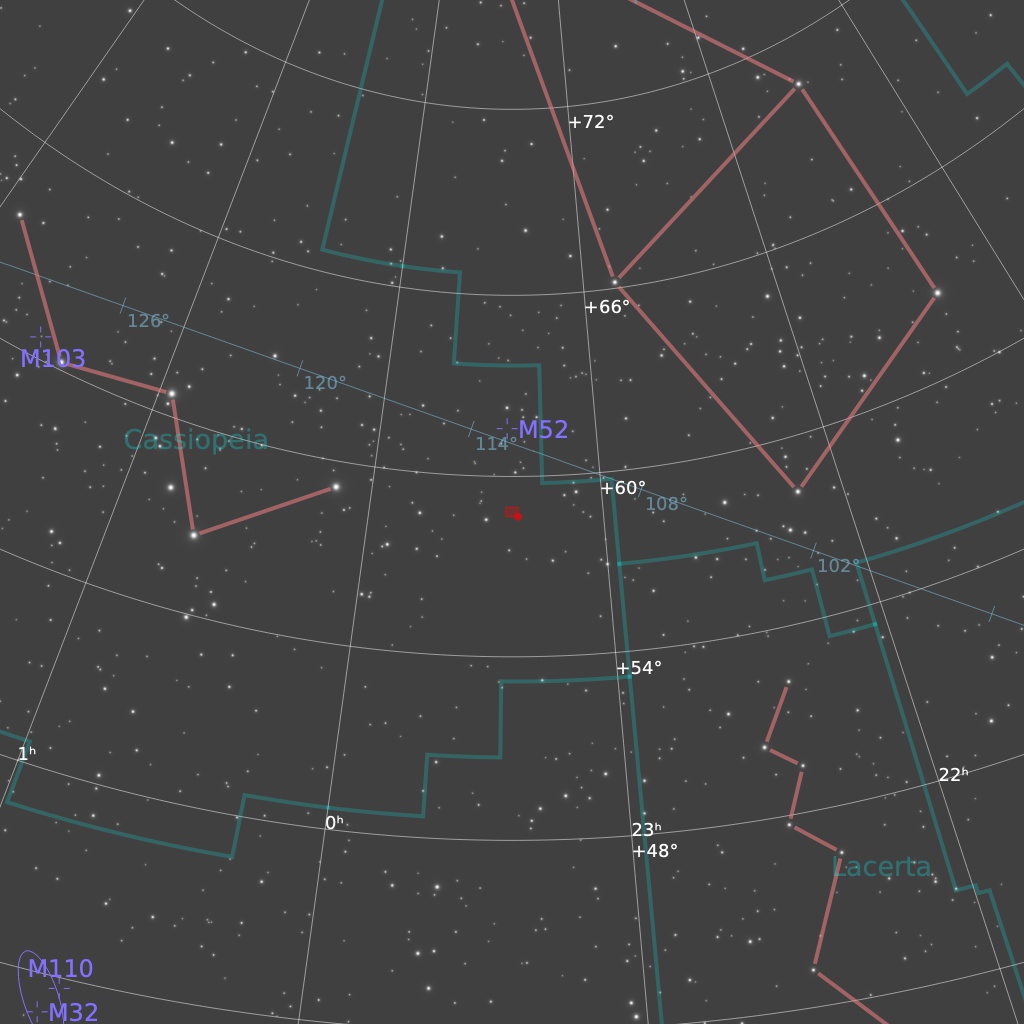
Cassiopeia A (Cas A) is a supernova remnant in the northern constellation of Cassiopeia. It seems to be rarely imaged by amateurs. It is about 11,000 light years from us, and 10 light years across. The teal hues in the image come mainly from oxygen emissions. The red in Cas A is mostly from sulfur emissions. The red elsewhere in the image is mostly due to hydrogen emissions. The light from this supernova is thought to have reached Earth in the late 1600s, but there are no records of its observation at that time. Although Cas A a very faint object at visual wavelengths shown in this image, it’s the brightest radio source in the sky, other than the Sun. It spans about 5 arcminutes on the sky, about 1/6 the diameter of the Moon. There’s a massive neutron star at the centre of the remnant.
Tekkies:
Acquisition, focusing, and control of Paramount MX mount with N.I.N.A., TheSkyX. Guiding with PHD2. Primalucelab low-profile 2″ Essato focuser, ARCO rotator and Giotto flat panel. Equipment control with PrimaLuce Labs Eagle 4 Pro computer. All pre-processing and processing in PixInsight. Acquired from my SkyShed in Guelph. Acquired under variable conditions from October 6 – November 18, 2025. I captured the broadband data when the moon was less intrusive.
Celestron 14″ EDGE HD telescope at f/11 (3,931 mm focal length) and QHY600M-SBFL camera binned 2×2 with Optolong filters.
40 x 5m Red = 3hr20m
40 x 5m Green = 3hr20m
38 x 5m Blue = 3hr10m
144 x 5m S2 = 12hr00m
141 x 5m Ha = 11hr45m
141 x 5m O3 = 11hr45m
Total: 45hr 20m
Preprocessing: The WeightedBatchPreProcessing script was used to perform calibration, cosmetic correction, weighting, registration, local normalization, integration, 2X Drizzle integration, auto-cropping and plate solving.
Colour master: A colour master was made from the Red, Green and Blue masters using ChannelCombination in RGB mode.
Gradient Removal: DynamicBackgroundExtraction was applied to the RGB and narrowband masters.
Colour Calibration: ColorCalibration was used to calibrate the colour of the RGB master.
Deconvolution: BlurXterminator was used on the RGB and narrowband masters with Automatic psf at default settings.
Linear Noise Reduction: NoiseXterminator was applied to the RGB and narrowband masters with settings Amount=0.9 and Iterations=3
Stretching: MultiscaleAdaptiveStretch was applied to the RGB and narrowband masters to make pleasing images. Approximate background level after the stretches was 0.10 for RGB and 0.09 for the individual narrowband masters.
Nonlinear Processing
Star Removal: StarXterminator was used to remove the stars from each of the RGB and narrowband masters, with default settings. Only the RGB stars-only image was preserved.
Background Cleanup: Artifacts that were visible in the master images were removed using the CloneStamp tool.
Nonlinear Noise Reduction: NoiseXterminator was used to reduce noise in the background areas of the RGB, and narrowband masters with settings Amount=0.9 and Iterations = 3
Addition of Sulfur and Oxygen: Seti-Astro’s CombineRGBandNarrowband script was used to add sulfur emissions to the red channel and oxygen emissions to the green and blue channels. This was followed by Seti-Astro’s CombineHaWithRGB script to add hydrogen emissions to the red and blue channel (about 6% blue).
Contrast Enhancement: HistogramTransformation was used to reset the black point and increase contrast. LocalHistogramEqualization was applied with a kernel radius of 40, a Contrast Limit of 1.5, strength 0.25 and 1 iteration.
Sharpening: A mask was used to select brighter regions of nebulosity for sharpening with MultiscaleMedianTransform (Layers 2 – 5 with strengths of 0.07, 0.05 , 0.03 and 0.03, respectively).
Star Processing and Restoration: HistogramTransformation was used to stretch the stars-only RGB image, followed by CurvesTransformation through a star mask to boost saturation using the Saturation slider. The stars were added back into the three master images using the PixelMath expression combine(starless, stars, op_screen()).
Final Steps: Background, nebula and star brightness, contrast and saturation were adjusted using several iterations of CurvesTransformation, with masks, as required. Stars were reduced with the Cosmic Photons StarReduction script. ICCProfileTransformation (sRGB IEC61966-2.1; Relative Colorimetric with black point compensation) was applied prior to saving as a jpg.

Leave A Comment