
Sh2-106
 Click image for full size version
February 10, 2026
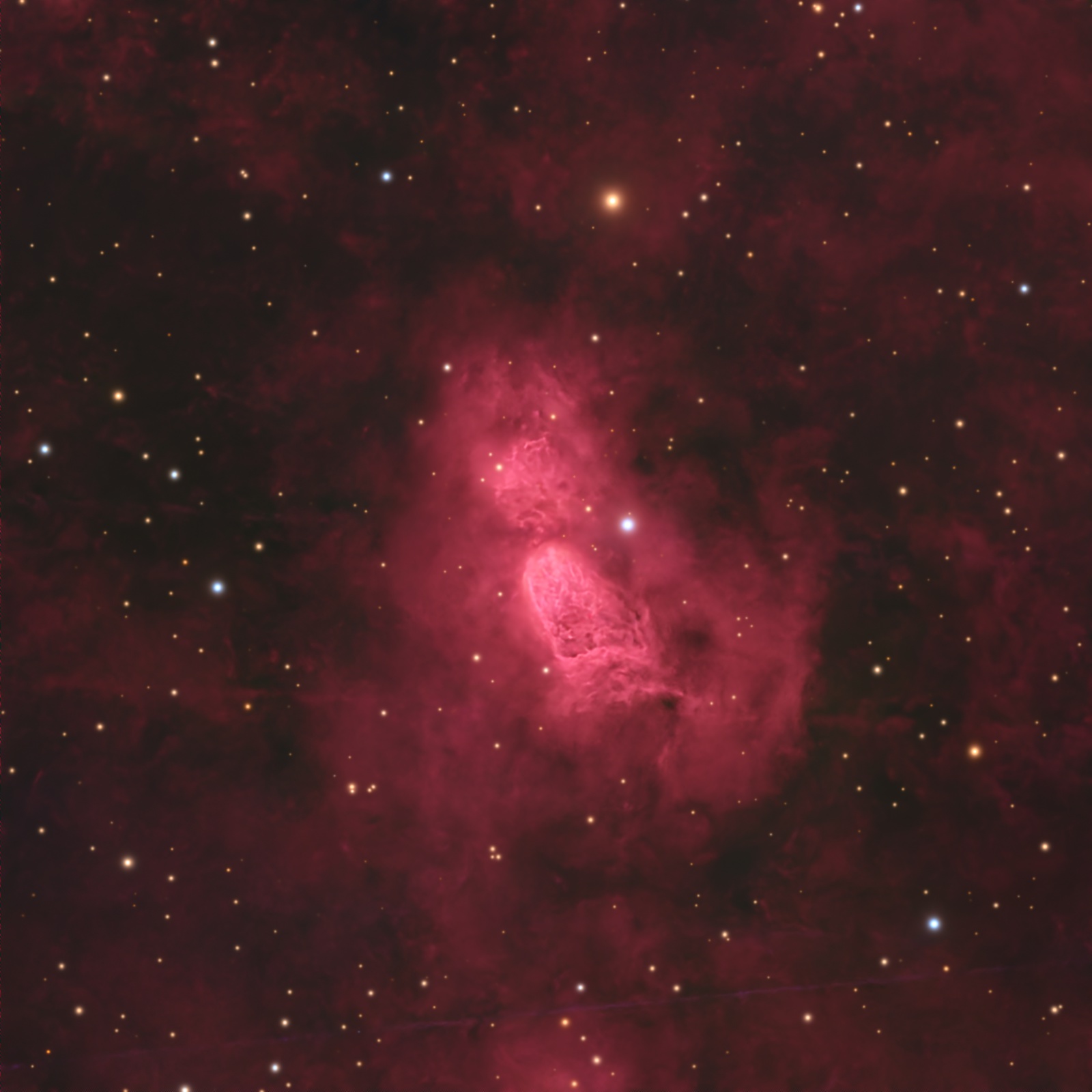
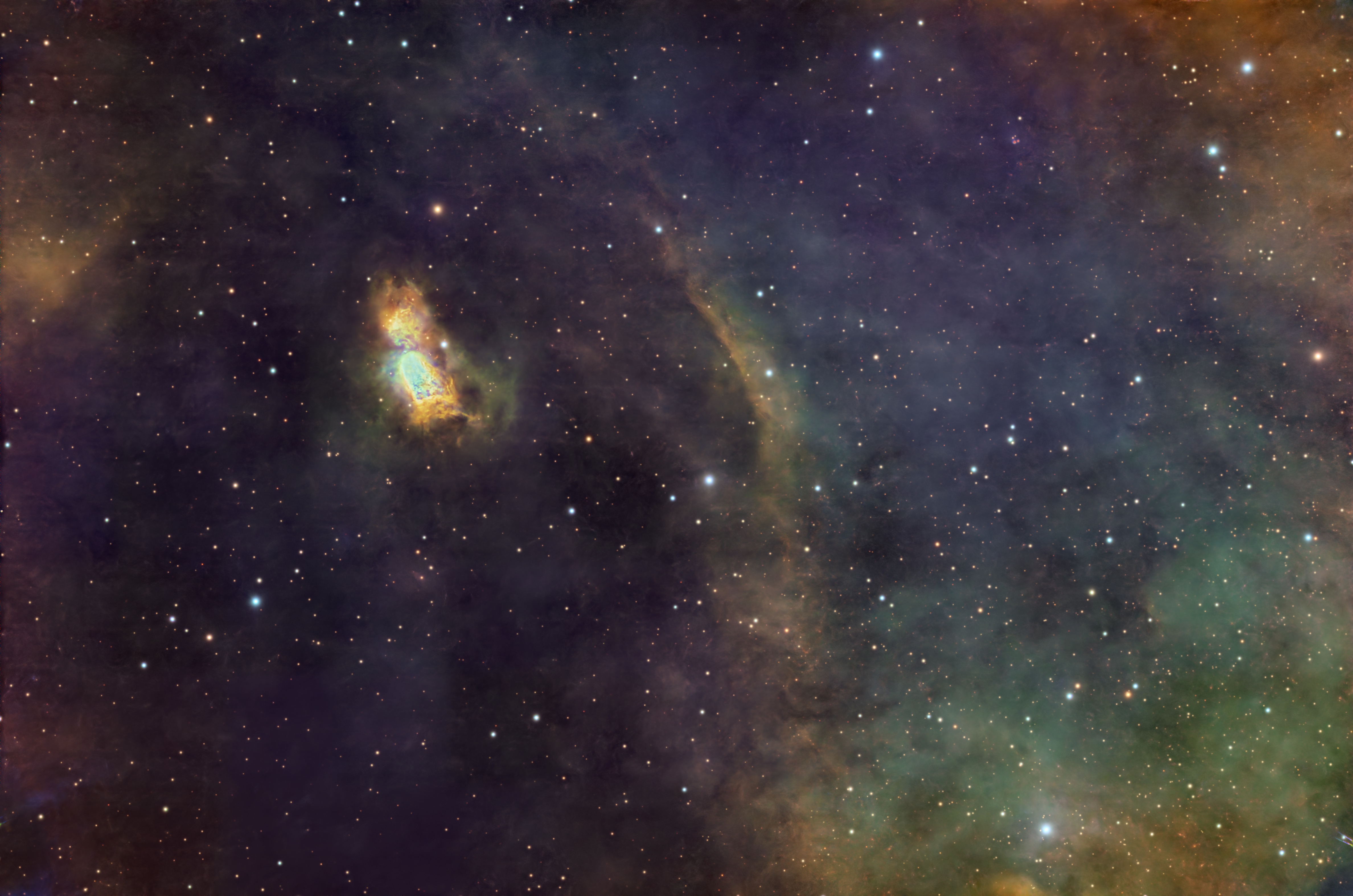
Sh2-106 is a bipolar emission nebula and star-forming region in Cygnus, about 2,000 light years away. A star at the centre with a mass 15 times the Sun’s is blowing out the two lobes. That star is also causing the surrounding gases to glow. Sh2-106 doesn’t seem to be a very popular target. That’s probably due to its small size and proximity to bigger and brighter targets, like the Crescent Nebula. In addition to the natural-colour image above, I created a Hubble palette version. Click the thumbnail below to see the full-resolution version.
Tekkies:
Acquisition, focusing, and control of Paramount MX mount with N.I.N.A., TheSkyX. Guiding with PHD2. Primalucelab low-profile 2″ Essato focuser, ARCO rotator and Giotto flat panel. Equipment control with PrimaLuce Labs Eagle 4 Pro computer. All pre-processing and processing in PixInsight. Acquired from my SkyShed in Guelph. Average transparency and seeing. Acquired under a waxing crescent moon from July 4 – August 11, 2025. I captured the broadband data when the moon was less intrusive.
Celestron 14″ EDGE HD telescope at f/11 (3,931 mm focal length) and QHY600M-SBFL camera binned 2×2 with Optolong filters.
23 x 5m Red = 1hr 55m
21 x 5m Green = 1hr 45m
21 x 5m Blue = 1hr45m
79 x 5m S2 = 6hr 35m
79 x 5m Ha = 6hr 35m
74 x 5m O3 = 6hr 10m
Total: 24hr 45m
Preprocessing: The WeightedBatchPreProcessing script was used to perform calibration, cosmetic correction, weighting, registration, local normalization, integration, Drizzle integration, auto-cropping and plate solving.
Colour master: A colour master was made from the Red, Green and Blue masters using ChannelCombination in RGB mode.
Gradient Removal: DynamicBackgroundExtraction was applied to the RGB and narrowband masters.
Colour Calibration: ColorCalibration was used to calibrate the RGB master.
Deconvolution: BlurXterminator was used on the RGB and narrowband masters with Automatic psf at default settings.
Linear Noise Reduction: NoiseXterminator was applied to the RGB and narrowband masters with settings Amount=0.9 and Iterations=3
Star Removal: StarXterminator was used to remove the stars from each of the RGB and narrowband masters, with default settings. Only the RGB stars-only image was preserved.
Hubble Palette Image Creation: The three narrowband masters were combined using ChannelCombination in RGB mode assigning S to red, H to green, and O to blue.
Stretching: MultiscaleAdaptiveStretch was applied to the RGB and SHO masters to make pleasing images. Approximate background level after the stretches was 0.10.
Nonlinear Processing
Background Cleanup: Artifacts that were visible in the three master colour images were removed using the CloneStamp tool.
Nonlinear Noise Reduction: NoiseXterminator was used to reduce noise in the background areas of the RGB, Hubble and OHS masters with settings Amount=0.9 and Iterations = 3
Narrowband Enhancement of RGB: The CIE L* channel was extracted from the SHO image using ChannelExtraction in the L*a*b* colour space. The CreateHDRImage script was used to combine the narrowband lightness with the RGB.
Dynamic Range Compression: The CreateHDRImage script was used to compress the core of the nebula using a mask made with the RangeSelection tool. This was applied to all three images.
Contrast Enhancement: LocalHistogramEqualization was applied twice to each image. A Contrast Limit of 1.5 and 1 iteration was used for each LHE application (scale 150, strength 0.35; scale 50, strength 0.22).
Sharpening: A mask was used to select brighter regions of nebulosity in each image for sharpening with MultiscaleMedianTransform (Layers 2 – 43with strengths of 0.07, 0.05 , 0.03 and 0.03, respectively).
Hubble Palette Colour Adjustments: CurvesTransformation was used with the Hue tool to adjust the colour tones in the two narrowband images. The SelectiveColorCorrection script was also applied to adjust colours.
Star Processing and Restoration: HistogramTransformation was used to stretch the stars-only RGB image, followed by CurvesTransformation through a star mask to boost saturation using the Saturation slider. The stars were added back into both master images using the PixelMath expression combine(starless, stars, op_screen()). The Cosmic Photons Star Reduction script was used to slighlty reduce the stars.
Final Steps: Background, nebula and star brightness, contrast and saturation were adjusted using several iterations of CurvesTransformation, with masks, as required. ICCProfileTransformation (sRGB IEC61966-2.1; Relative Colorimetric with black point compensation) was applied prior to saving as a jpg.

Thanks Ron.
I always appreciate your posts.
Magnificent work.
All the best.
sg.
Thank you Ron for your beautiful work. Seeing your spectacular photos makes me smile and leaves me in awe. They remind me of the unknown and endless world of wonder out there beyond what we see on the daily here. Thank you!!!