
M1 – The Crab Nebula in Four Colour Palettes
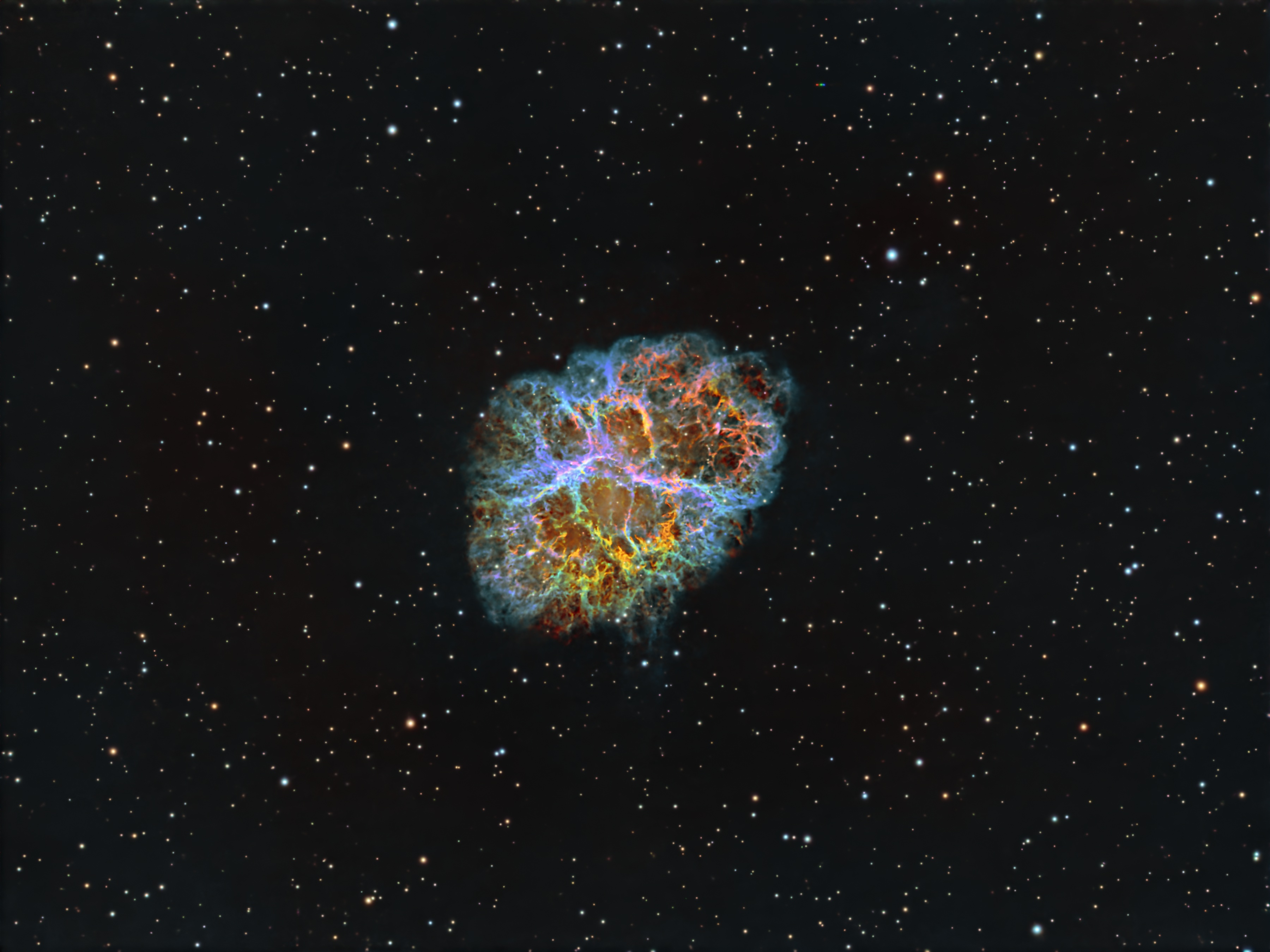 Foraxx Palette |
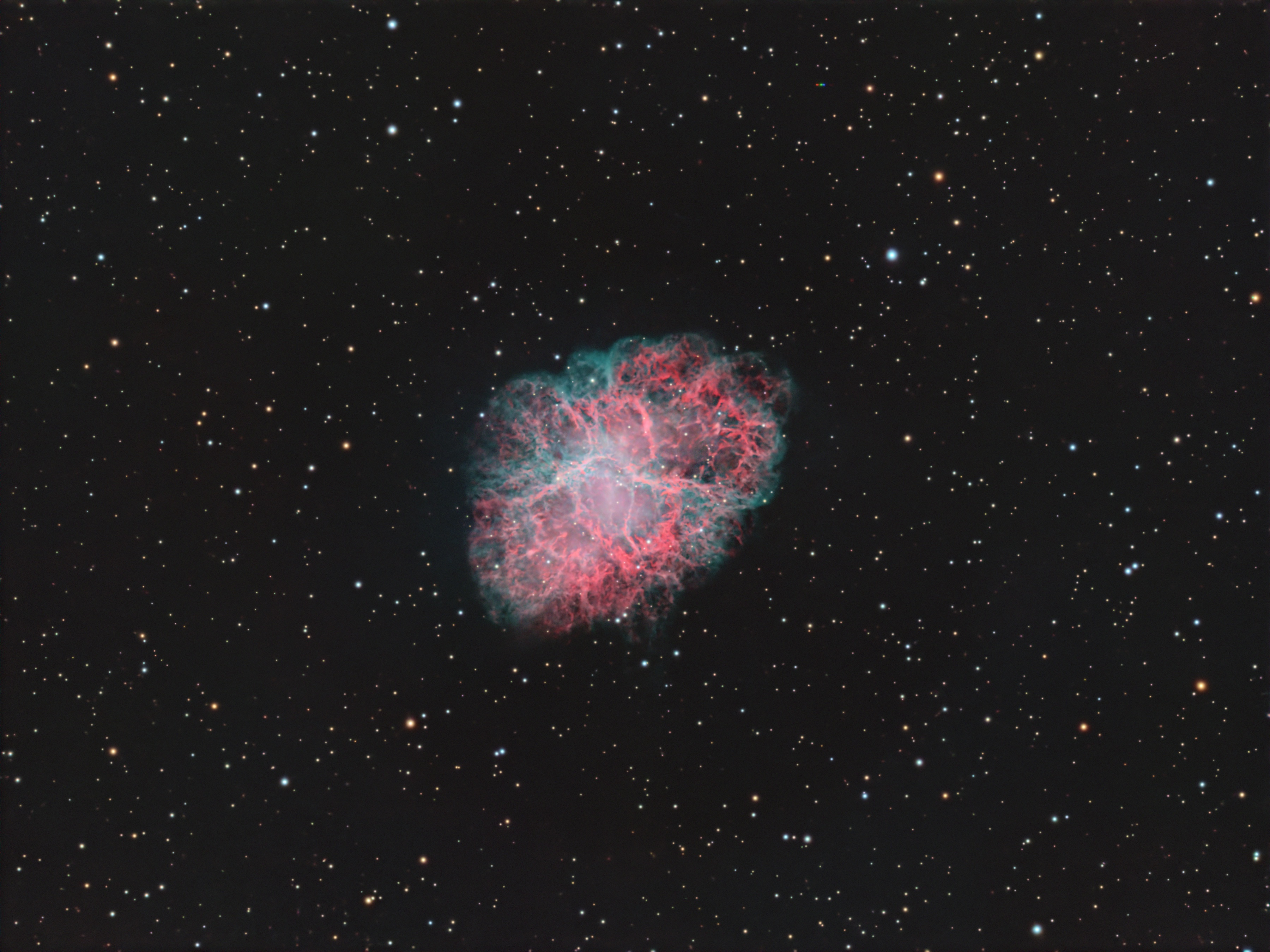 RGB Enhanced with SHO |
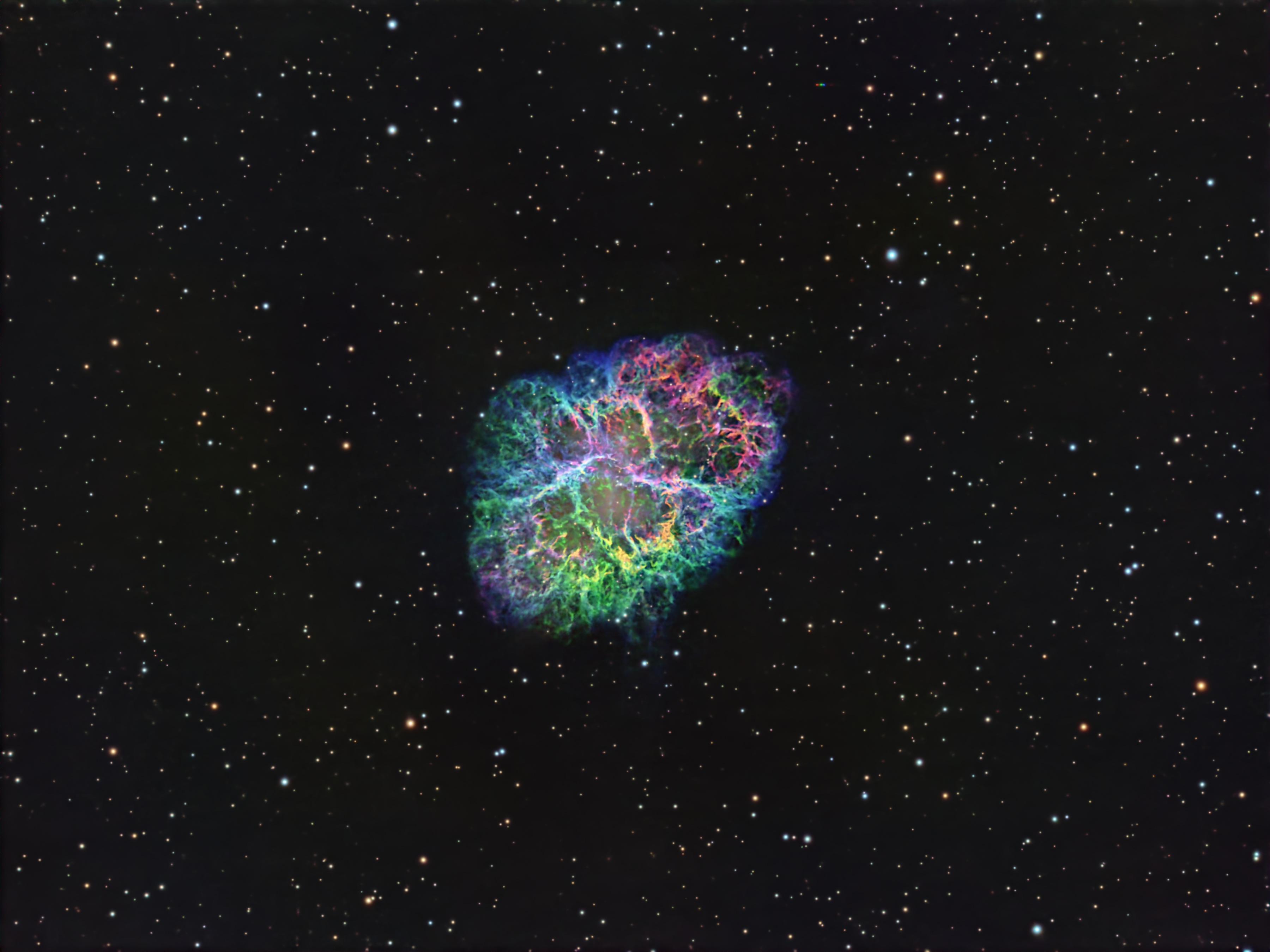 Hubble Palette |
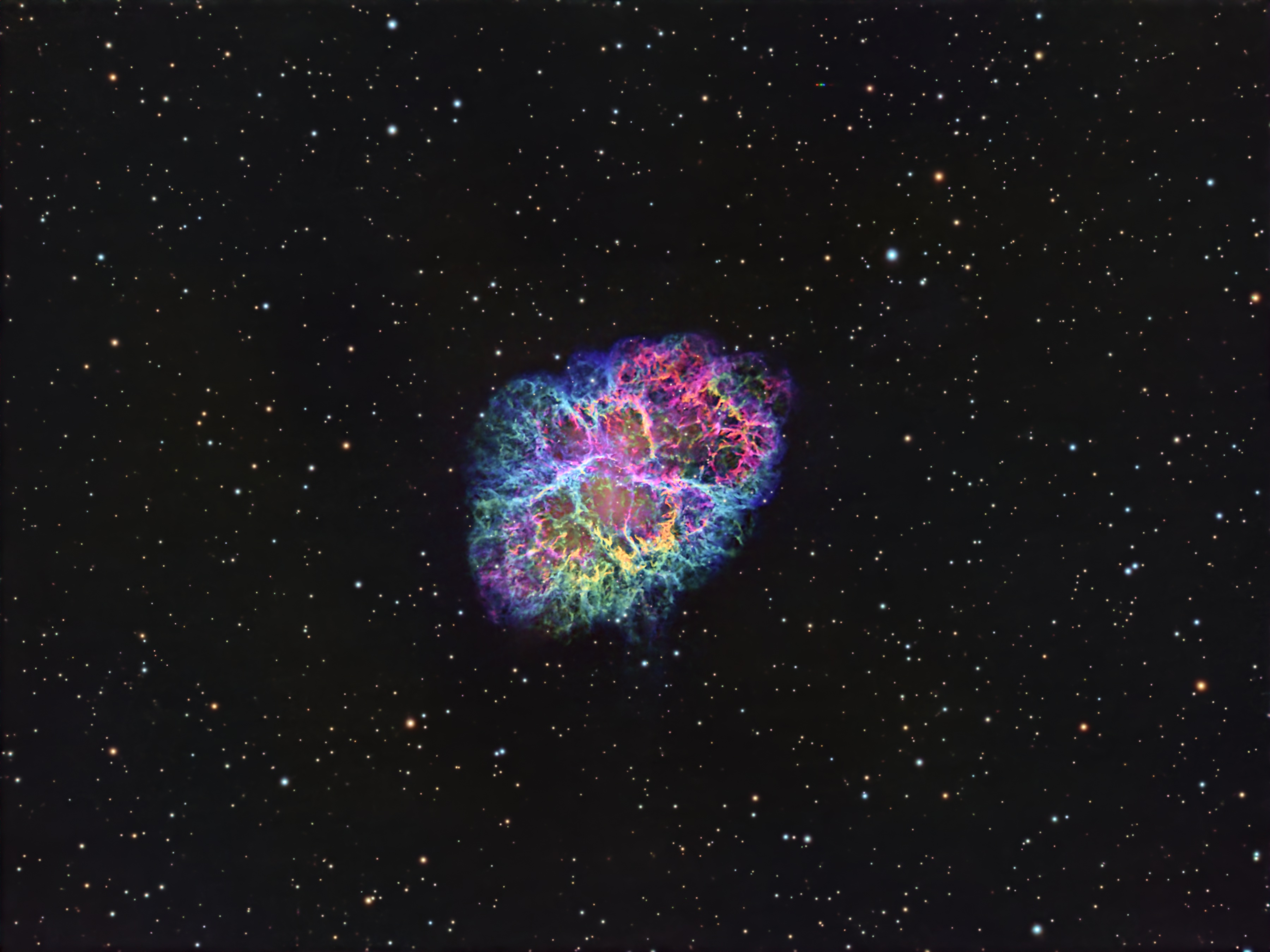 Modified Hubble Palette |
Click image for full size version
March 18, 2026
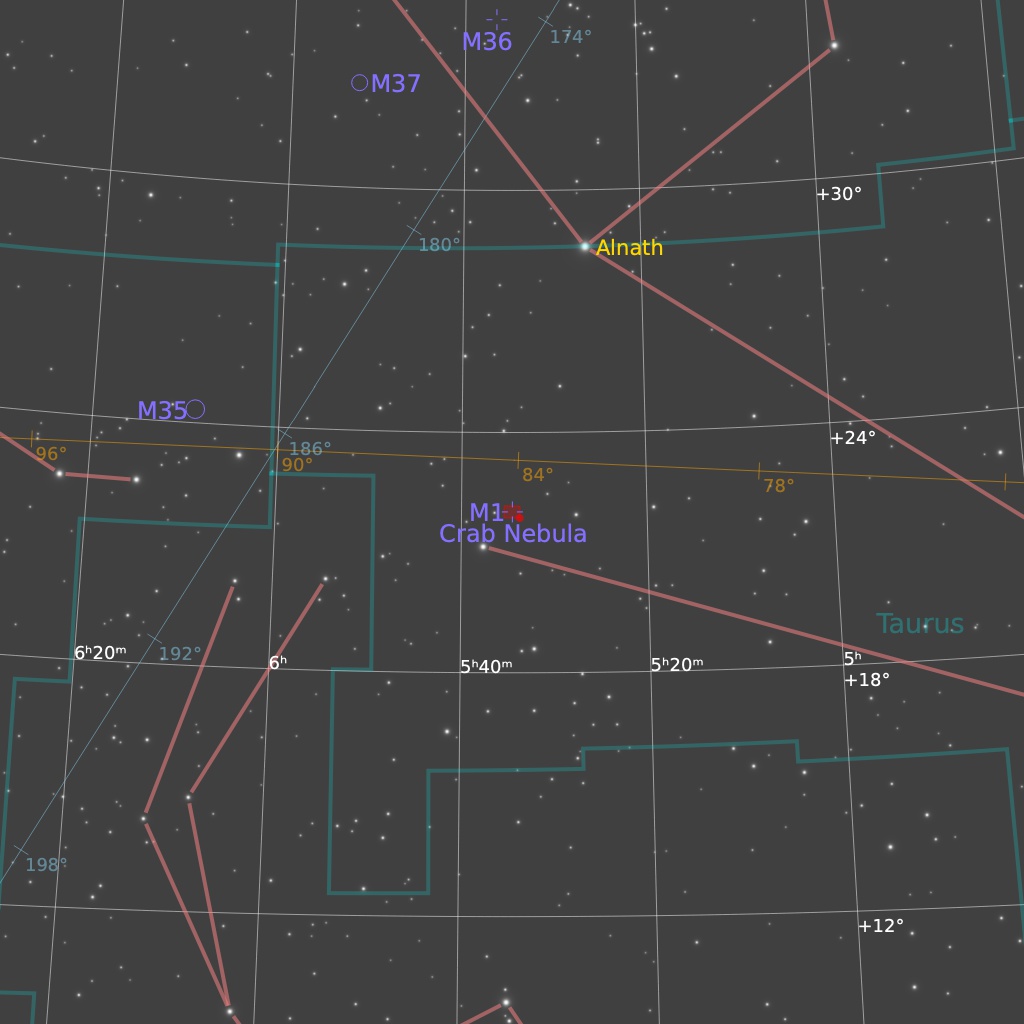
M1, the Crab Nebula, is a remnant of a supernova caused by the explosion of a massive star about 6,500 light years away in the constellation of Taurus, the Bull. The progenitor star exploded in July 1054 A.D. and was seen and documented by people around the world. It was visible during the day for three weeks. M1 is the first entry in Charles Messier’s famous catalogue of not-comets.
The glow of this supernova remnant is powered by a neutron star at the centre, the dense core left over from the explosion. The tiny yet massive star spins more than 30 times per second, and appears to emit pulses of gamma rays, so is known as a ‘pulsar.’ It is the strongest persistent source of X-rays and gamma rays over 30 kEV. We are lucky to get to see it, because objects like this dissipate and fade out of visibility gradually over time.
Tekkies:
Acquisition, focusing, and control of Paramount MX mount with N.I.N.A., TheSkyX. Guiding with PHD2. Primalucelab low-profile 2″ Essato focuser, ARCO rotator and Giotto flat panel. Equipment control with PrimaLuce Labs Eagle 4 Pro computer. All pre-processing and processing in PixInsight. Acquired from my SkyShed in Guelph. Below average transparency and seeing. Acquired under strong moonlight from February 27 to March 3, 2026.
Celestron 14″ EDGE HD telescope at f/11 (3,931 mm focal length) and QHY600M-SBFL camera binned 2×2 with Optolong filters.
11 x 1m Red = 0hr11m
10 x 1m Green = 0hr10m
10 x 1m Blue = 0hr10m
29 x 5m S2 = 2hr25m
31 x 5m Ha = 2hr35m
33 x 5m O3 = 2hr45m
Total: 8hr16 m
Preprocessing: The WeightedBatchPreProcessing script was used to perform calibration, cosmetic correction, weighting, registration, local normalization, integration, and auto-cropping.
Colour masters: A natural-olour master was made from the Red, Green and Blue masters using ChannelCombination in RGB mode. A Hubble palette master was made the same way using the Sulfur, Hydrogen and Oxygen masters.
Gradient Removal: DynamicBackgroundExtraction was applied to the RGB and Hubble palette masters.
Colour Calibration: ColorCalibration was used to calibrate the RGB master. Background neutralization was applied to the Hubble palette master.
Deconvolution: BlurXterminator was used on the RGB and Hubble palette masters with Automatic psf with star shrink at 0.5 and non-stellar amount at 0.95.
Linear Noise Reduction: NoiseXterminator was applied to the RGB and Hubble palette masters with settings Amount=0.9 and Iterations=3
Star Removal: StarXterminator was used to remove the stars from the RGB and Hubble palette, with default settings. Only the RGB stars-only image was preserved.
Stretching: MultiscaleAdaptive Stretch was applied to the RGB and Hubble palette masters to make pleasing images. Approximate background level after the stretches was 0.10 for both images.
Nonlinear Processing
Nonlinear Noise Reduction: NoiseXterminator was applied to the RGB and Hubble palette with settings Amount=0.9 and Iterations = 3
Contrast Enhancement: LocalHistogramEqualization was applied twice to the Hubble palette master. A Contrast Limit of 1.5 and 1 iteration was used for each LHE application (scale 125, strength 0.25; scale 40, strength 0.18).
Sharpening: A mask was used to select brighter regions of nebulosity in the Hubble palette master for sharpening with MultiscaleMedianTransform (Layers 2 – 43with strengths of 0.07, 0.05 , 0.03 and 0.03, respectively).
Narrowband Channel Extraction: In preparation for making additional images, the red, green and blue colour channels were extracted from the Hubble palette master. They were renamed S, H, and O, respectively.
Enhanced RGB Image Creation: The stretched S, H and O masters were combined with the RGB image using Jurgen Terpe’s CombineHaWithRGB script to add Ha mainly to the red channel, with a little contribution to the blue. This was followed by the CombineRGBandNarrowband script to add S to the red channel and O to both the green and blue channels.
Foraxx Palette Image Creation: The S, H and O masters were combined with Paul Hancock’s Foraxx Palette Utility script.
Modified Hubble Palette Image Creation: A copy of the Hubble palette image was adjusted using the CurvesTransformation process and slight reduction of green with SCNR.
Hubble Palette Colour Adjustments: Jurgen Terpe’s SelectiveColorCorrection script and the CurvesTransformation Hue tool were used to adjust the colour tones in the Hubble palette image.
Star Processing and Restoration: HistogramTransformation was used to stretch the stars-only RGB image, followed by CurvesTransformation through a star mask to boost saturation using the Saturation slider. The stars were added back into the four master images using the PixelMath expression combine(starless, stars, op_screen()).
Final Steps: Background, nebula and star brightness, contrast and saturation were adjusted using several iterations of CurvesTransformation, with masks, as required. ICCProfileTransformation (sRGB IEC61966-2.1; Relative Colorimetric with black point compensation) was applied prior to saving as a jpg.

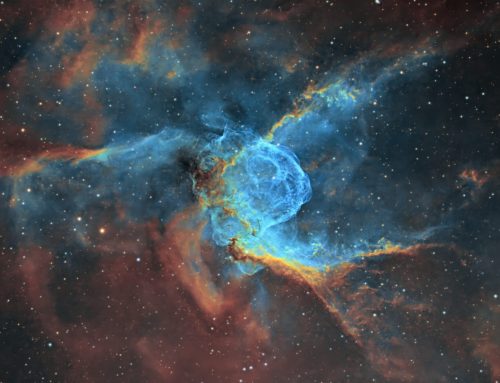
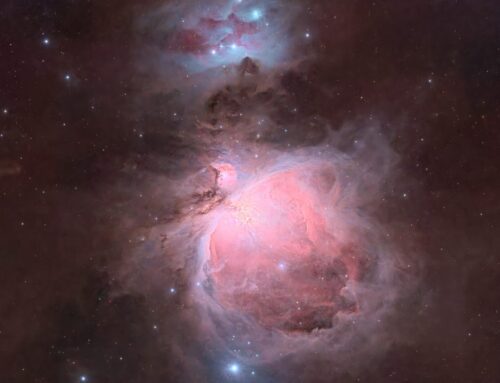
They are all great but my favorite is RGB Enhanced with SHO.
I shot this in the fall with 2600MC duo and an 11″ sct it is one of my favorites I shot it in SHO a while back with a 130 Apo but I am liking the OSC showing the cloud created by the synchrotron radiation from the spinning pulsar.