
The Leo Trio – M65, M66 and NGC 3628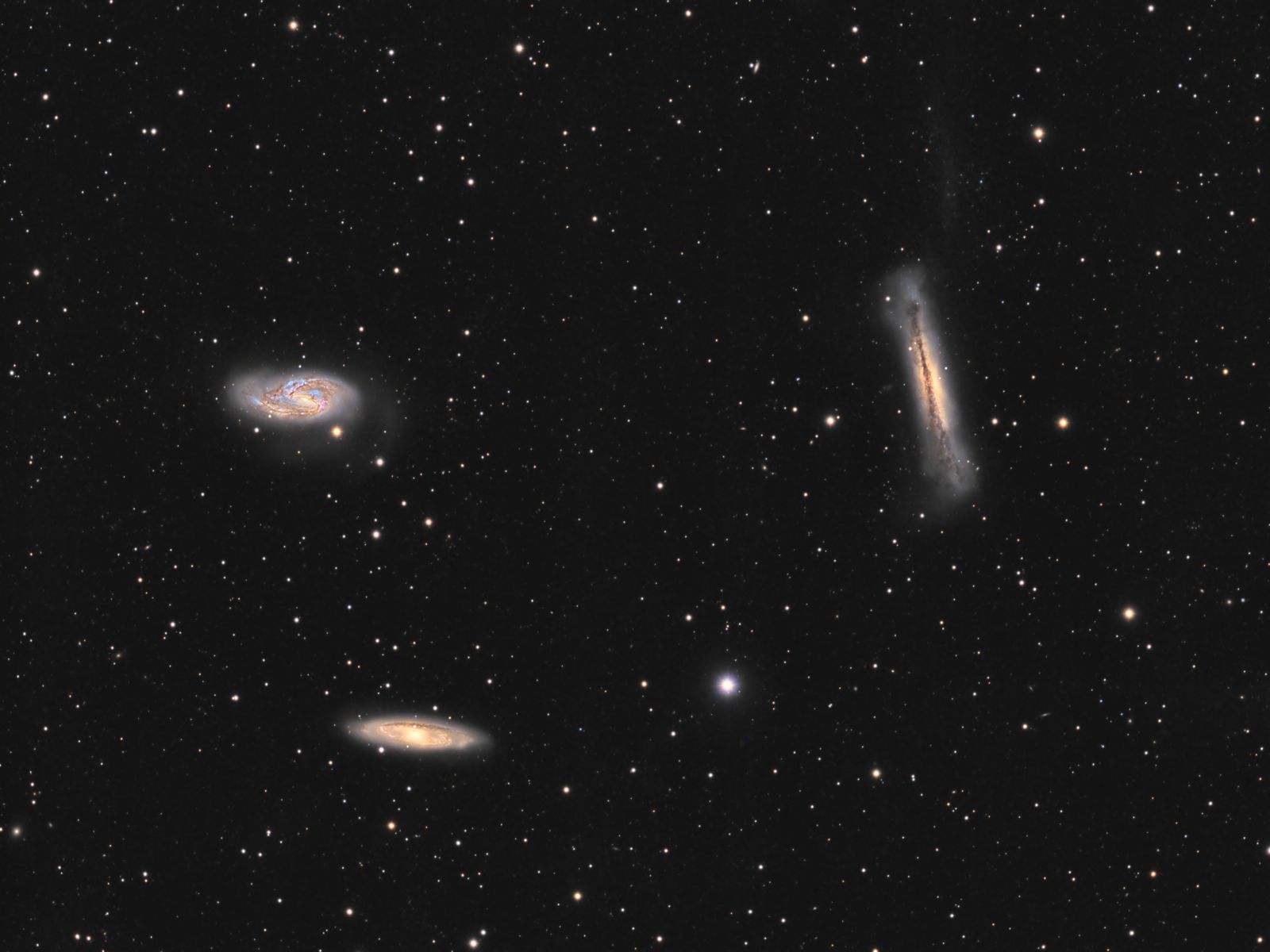
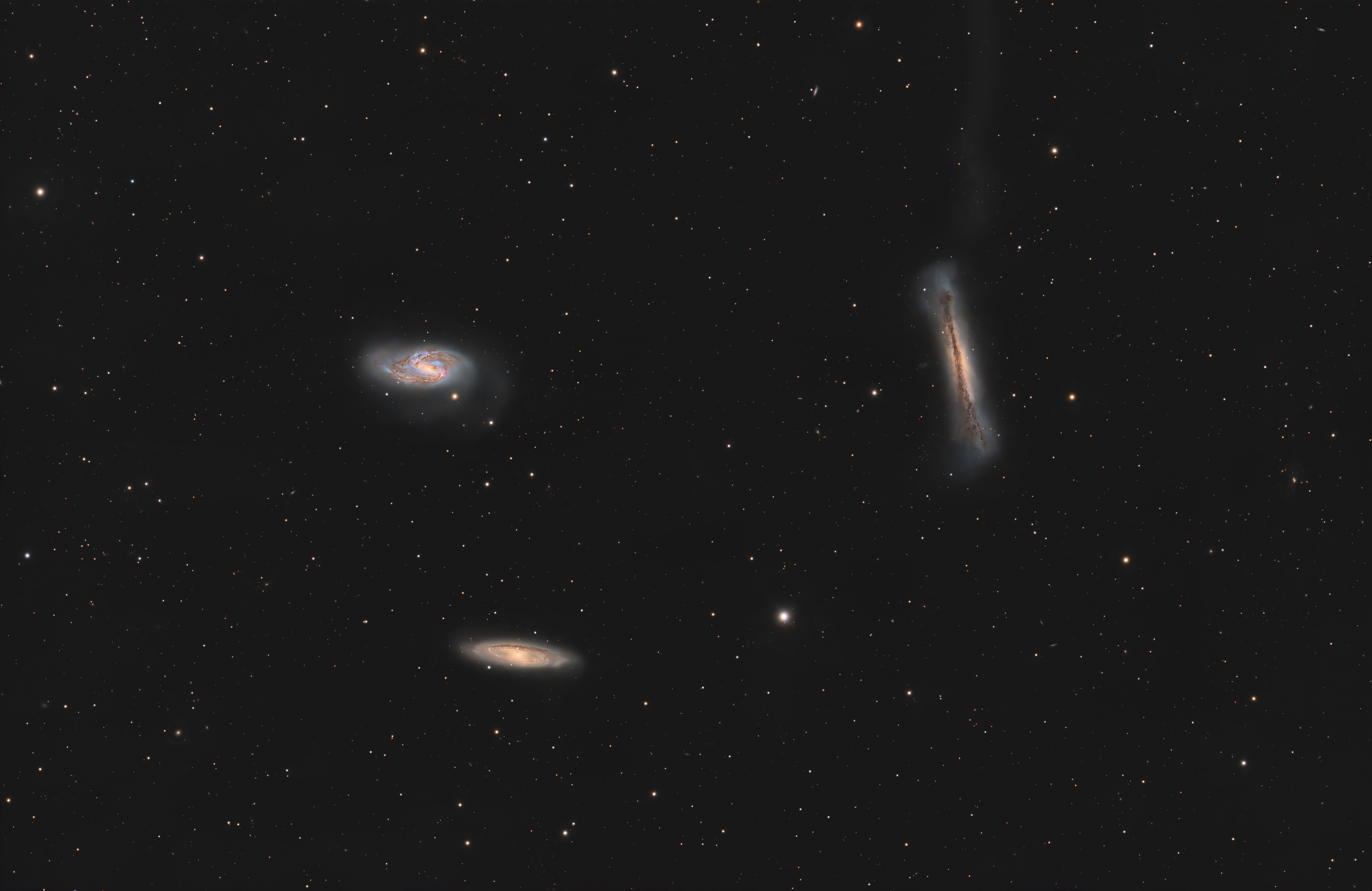
Click image for full size version
May 7, 2026
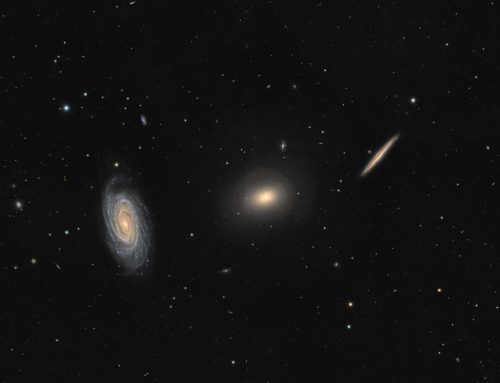
M65 (lower left), M66 (upper left) and NGC3628 are three galaxies in the constellation Leo. This grouping is known as the Leo Trio or Leo Triplet. This group of galaxies is around 30 million light years away. The annotated version shows many more galaxies in the distant background, but there are still more that are not marked. M65 shows much less star formation than M66, which shows blue knots of stars and pink nebulae. It is deformed from interacting with NGC 3628, which sports a faint 300.000 light year-long tidal tail at upper right.
Tekkies:
Acquisition, focusing, and control of Sky-Watcher Wave 150i mount and other equipment with N.I.N.A. and Green Swamp Server. Primalucelab 3″ ESATTO focuser, ARCO rotator, GIOTTO flat panel and ALTO cover motor. Equipment control with Primalucelab EAGLE 6 Pro computer. All pre-processing and processing in PixInsight. Acquired from my SkyShed in Guelph. Acquired under above average transparency and seeing and moderate moonlight from April 19 – 27, 2026.
Sky-Watcher Esprit 120, QHY168C camera, Optolong L-Quad Enhance filter.
115 x 5m = 9hr 35m
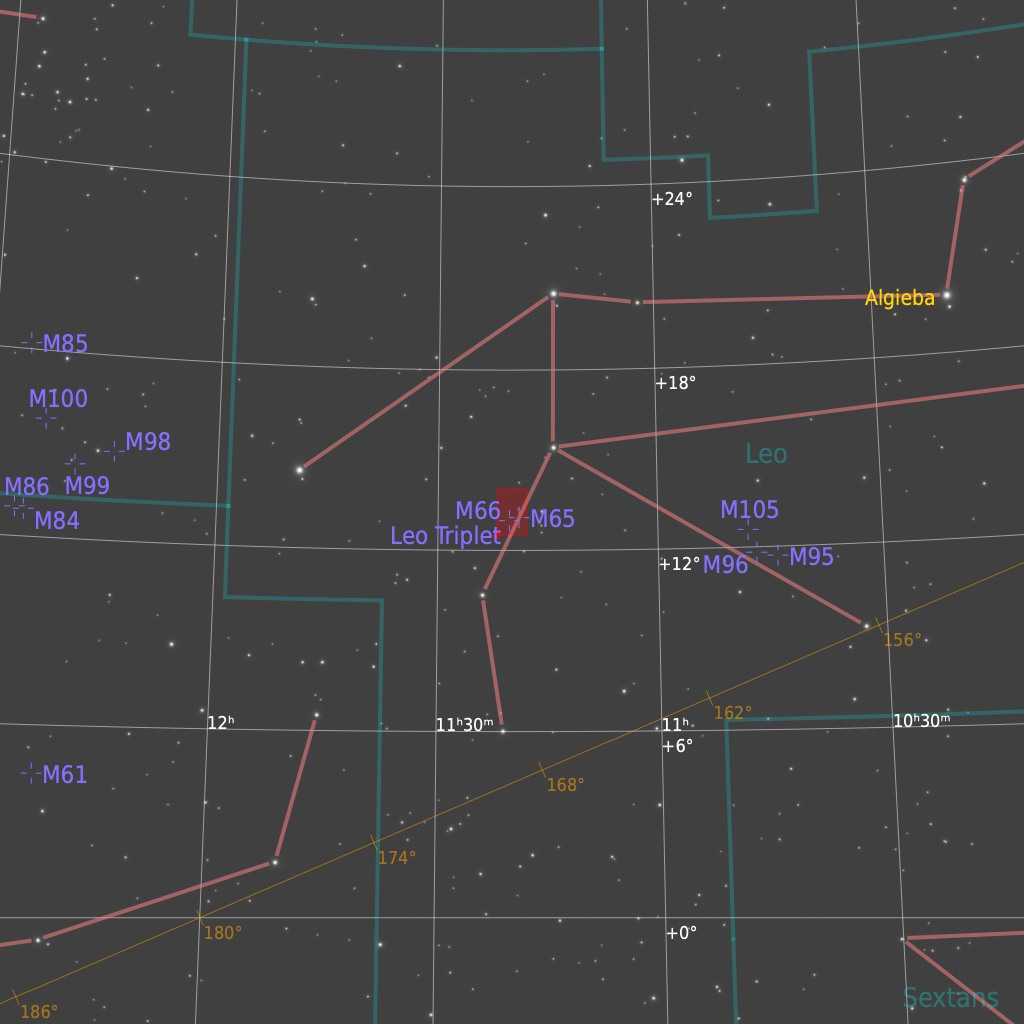
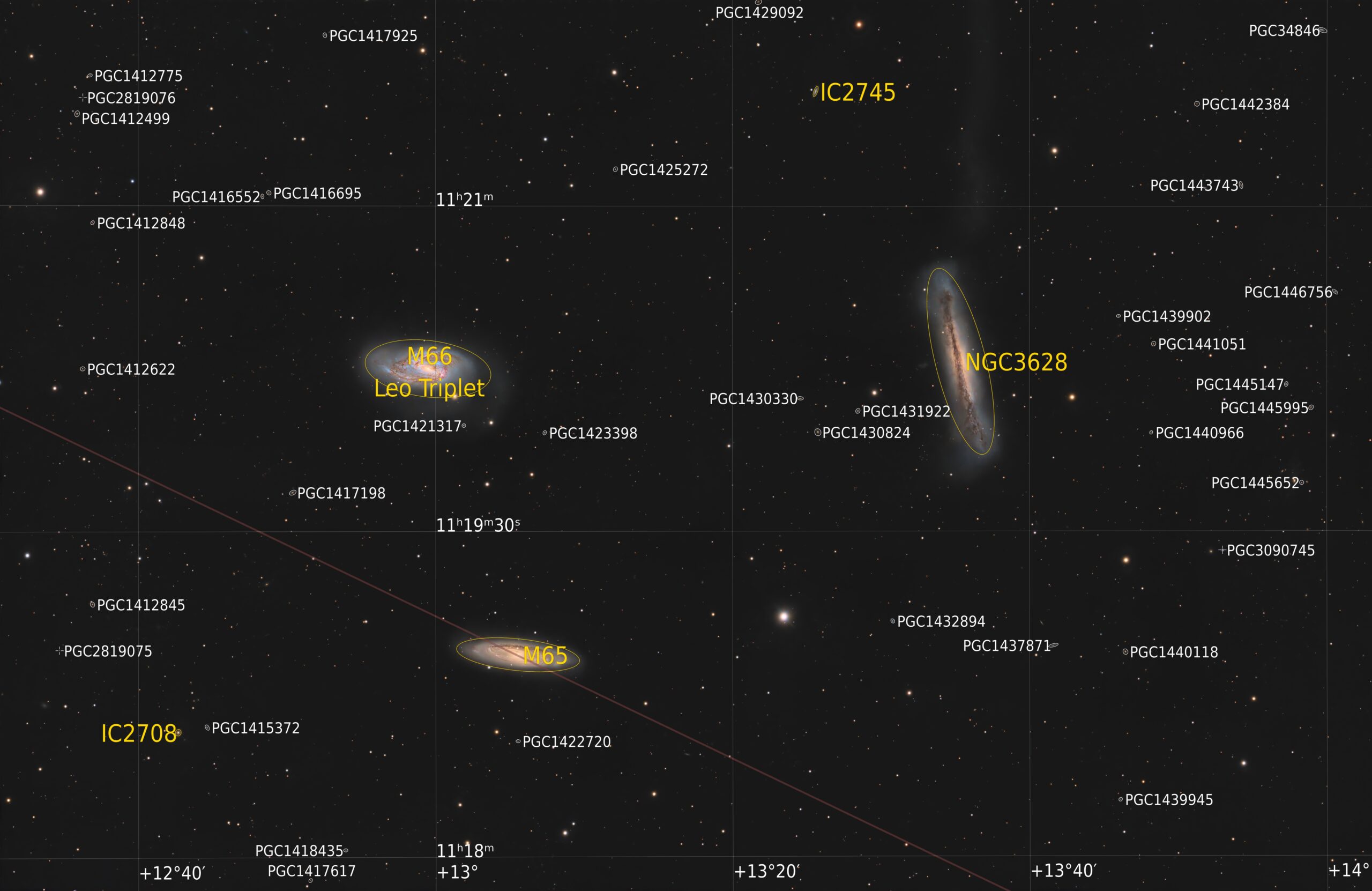
Preprocessing: The WeightedBatchPreProcessing script was used to perform calibration, cosmetic correction, debayering, weighting, registration, integration and Drizzle integration of all frames (2x drizzle, 0.9 Drop Shrink, Gaussian kernel).
Gradient Removal: DynamicBackgroundExtraction was applied to remove gradients and most of the colour imbalance.
Colour Calibration: ColorCalibration was used to balance the colours.
Deconvolution: BlurXterminator was applied to the RGB master with Automatic psf , star sharpening set to 0.5, and non-stellar set to 0.9.
Linear Noise Reduction: NoiseXterminator was applied with settings Amount=0.9 and Iterations=4.
Stretching: MultiscaleAdaptive Stretch was applied to make a pleasing image with background approximately 0.1.
Nonlinear Processing
Star Removal: StarXterminator was used to remove the stars from the master using default settings, except Large Overlap was selected. The stars-only image was retained and processed as described below.
Nonlinear Noise Reduction: NoiseXterminator was applied to the starless image with Amount=0.9 and Iterations = 4
Re-stretch: HistogramTransformation was used to boost contrast in the starless image by raising the dark point about halfway to the toe of the histogram and slightly decreasing the mid-point slider.
Contrast Enhancement: HDRMultiscaleTransform was applied through a mask with 6 layers, and Intensity reduced to 0.15. Then LocalHistogramEqualization was applied twice using the same mask. A Contrast Limit of 1.5 and 1 iteration was used for each LHE application (scale 150, strength 0.25; scale 40, strength 0.18).
Sharpening: BlurXterminator was applied with star sharpening off, auto PSF and amount of 0.05.
Stars-only steps: The CIE L* channel (i.e. the lightness channel) was extracted from the stars-only image using ChannelExtraction and was then applied to the star image as a mask. CurvesTransformation’s Saturation slider was used to boost colour in the stars.
Star Restoration: The PixelMath expression combine(starless, stars, op_screen()) was used to combine the starless starless image with the stars-only image.
Final Steps: Background, galaxy, and star brightness, contrast, and saturation were adjusted in several iterations using CurvesTransformation with masks as required. ICCProfileTransformation (sRGB IEC61966-2.1; Relative Colorimetric with black point compensation) was applied prior to saving as a jpg. The finder chart was made using the FindingChart process. The annotated image was made with the AnnotateImage script.

Very nice detail and colour Ron
Ron, we haven’t chatted for a long time, but I just wanted to let you know how much I enjoy seeing your images… Fantastic… every time I see one I am amazed and impressed… keep up the good work!
That is an awesome image!