
Messier 13 – Poseidon-C Pro First Light
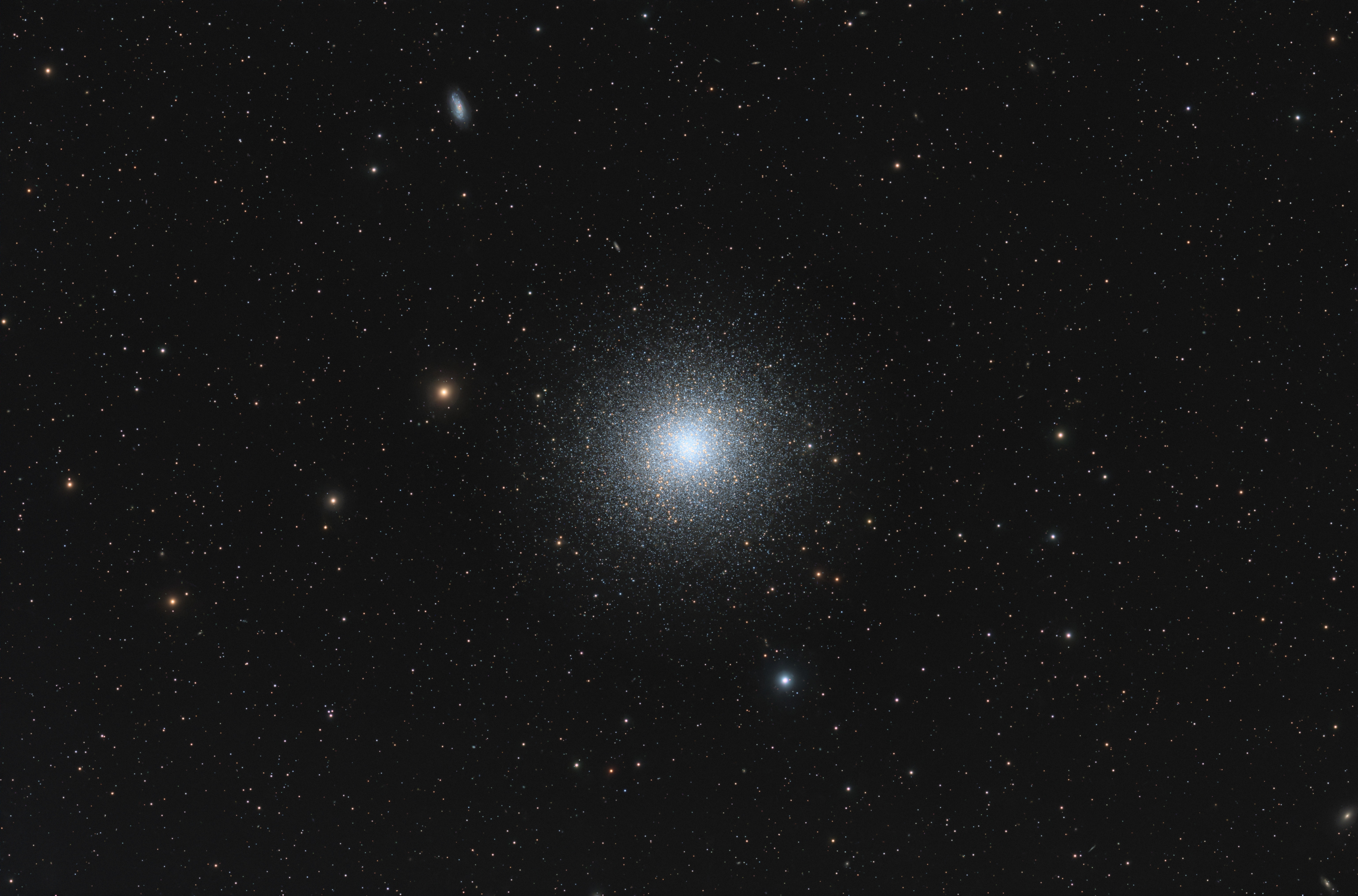 Click image for full size version
May 28,2026
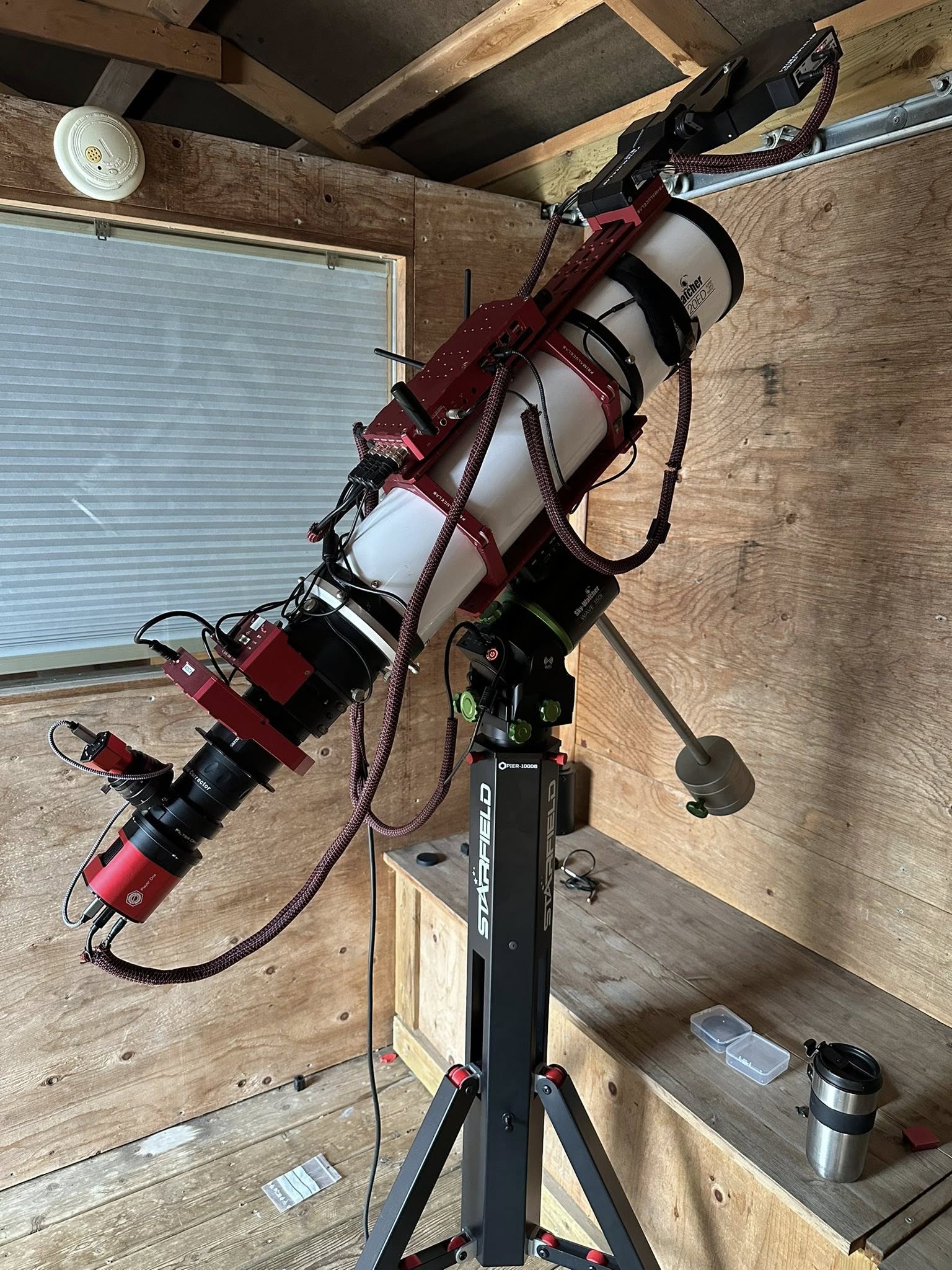
This is the first light for my new camera, a Player One Poseidon-C Pro. It is on my Sky-Watcher Esprit 120, along with all the fixins from Primalucelab (computer, focuser, rotator, flat panel, cover motor, dew management). The whole rig is on a Sky-Watcher Wave 150i, which is supported by a Starfield Tri-Pier 1000B. What a setup.
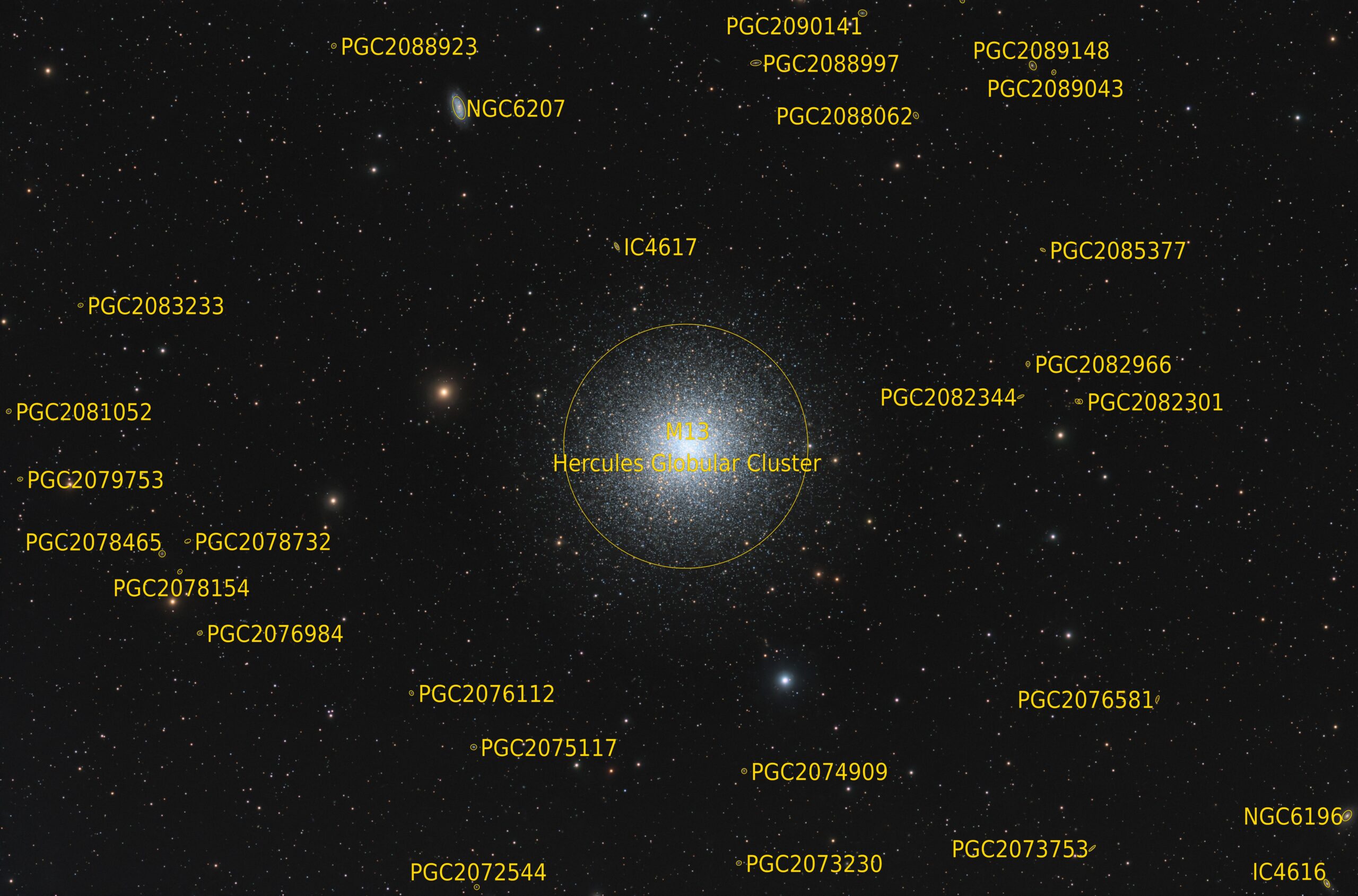
 There are about 150 globular clusters orbiting the main part of the Milky Way, and they are common around other galaxies too. These objects are star clusters of a few hundred thousand to a few million stars and they are very old objects. The Hercules Cluster, M13, is arguably the finest globular cluster visible from the northern hemisphere but lots of people, including me, have other favourites, like M3, M5, and M22. M13 lies about 22,000 light years away from us, and is about 2/3 the width of the full Moon. It contains about 600,000 stars and is about 168 light years across. The night sky would be very interesting from a star in the core of that cluster!
M13 is visible to the naked eye in moderately dark skies, obvious in binoculars, pretty in a small scope and stunning in a big scope. It’s one of my favourite objects to look at through any instrument, and I’ve imaged it several times before, for example in 2021, and again in 2024.
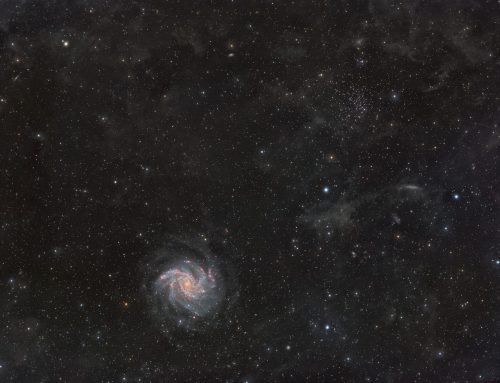
One of the features I always look for at the eyepiece and in images of M13 is a slightly dark propeller shape, which is quite obvious in this image a little below left of centre (North is up in this image). Also note galaxy NGC 6207 to the upper left of M13. I did a separate process of it. Click the pic to see it full size.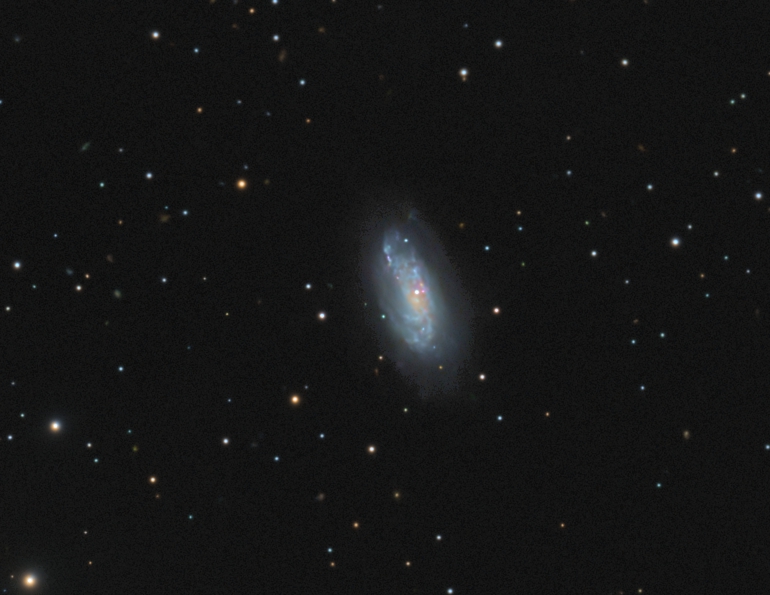
Tekkies:
Acquisition, focusing, and control of Sky-Watcher Wave 150i mount and other equipment with N.I.N.A. and Green Swamp Server. Primalucelab 3″ ESATTO focuser, ARCO rotator, GIOTTO flat panel and ALTO cover motor. Equipment control with Primalucelab EAGLE 6 Pro computer. All pre-processing and processing in PixInsight. Acquired from my SkyShed in Guelph. Acquired under above average transparency and seeing and moderate moonlight from May 21-26, 2026.
Sky-Watcher Esprit 120, Player One Poseidon-C Pro camera, Optolong L-Quad Enhance filter.
78 x 5m = 6hr 30m
16 x 1m = 0hr 16m
Total = 6hr 46m
Preprocessing: The WeightedBatchPreProcessing script was used to perform calibration, cosmetic correction, debayering, weighting, registration, and ntegration.
Gradient Removal: DynamicBackgroundExtraction was applied to remove gradients and most of the colour imbalance.
Colour Calibration: BlurXterminator was applied to the RGB master with Correct Only selected, followed by SpectrophotometricColorCalibration.
Deconvolution: BlurXterminator was applied to the RGB master with Automatic psf , star sharpening set to 0.5, and non-stellar set to 0.9.
Stretching: MultiscaleAdaptive Stretch was applied to make a pleasing image with background approximately 0.1.
Nonlinear Processing
Star Removal: StarXterminator was used to remove the stars from the master using default settings, except Large Overlap was selected. The stars-only image was retained and processed as described below.
Nonlinear Noise Reduction: NoiseXterminator was applied to the starless image with Amount=0.9 and Iterations = 4
Re-stretch: HistogramTransformation was used to boost contrast in the starless image by raising the dark point about halfway to the toe of the histogram and slightly decreasing the mid-point slider.
Contrast, Brightness and Colour: Brightness, contrast, hue, and saturation were adjusted in several iterations using CurvesTransformation.
Stars-only steps: The CIE L* channel (i.e. the lightness channel) was extracted from the stars-only image using ChannelExtraction and was then applied to the star image as a mask. CurvesTransformation’s Saturation slider was used to boost colour in the stars.
Star Restoration: The PixelMath expression combine(starless, stars, op_screen()) was used to combine the starless starless image with the stars-only image.
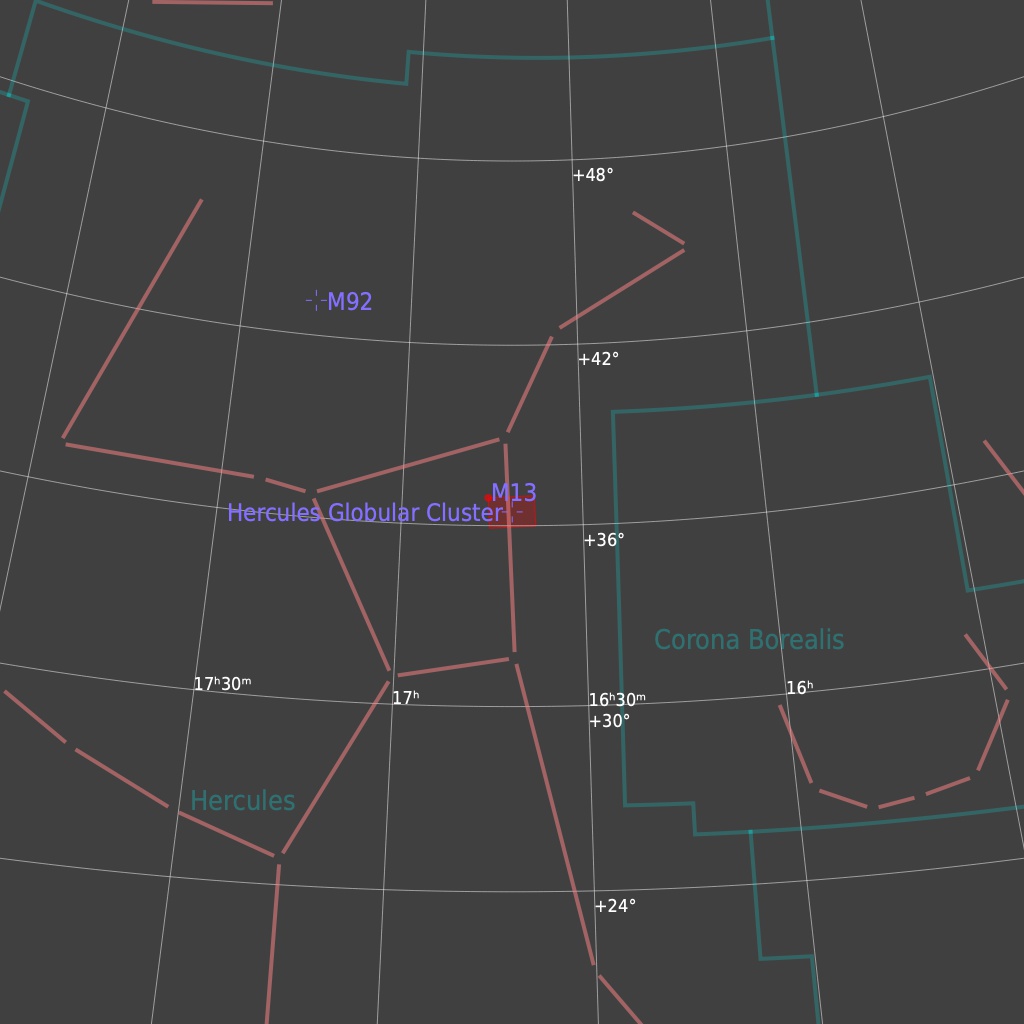
Final Steps: Background, galaxy, and star brightness, contrast, and saturation were adjusted in several iterations using CurvesTransformation with masks as required. ICCProfileTransformation (sRGB IEC61966-2.1; Relative Colorimetric with black point compensation) was applied prior to saving as a jpg. The finder chart was made using the FindingChart process. The annotated image was made with the AnnotateImage script.

Leave A Comment