
Messier 71
 Click image for full size version
June 21, 2026
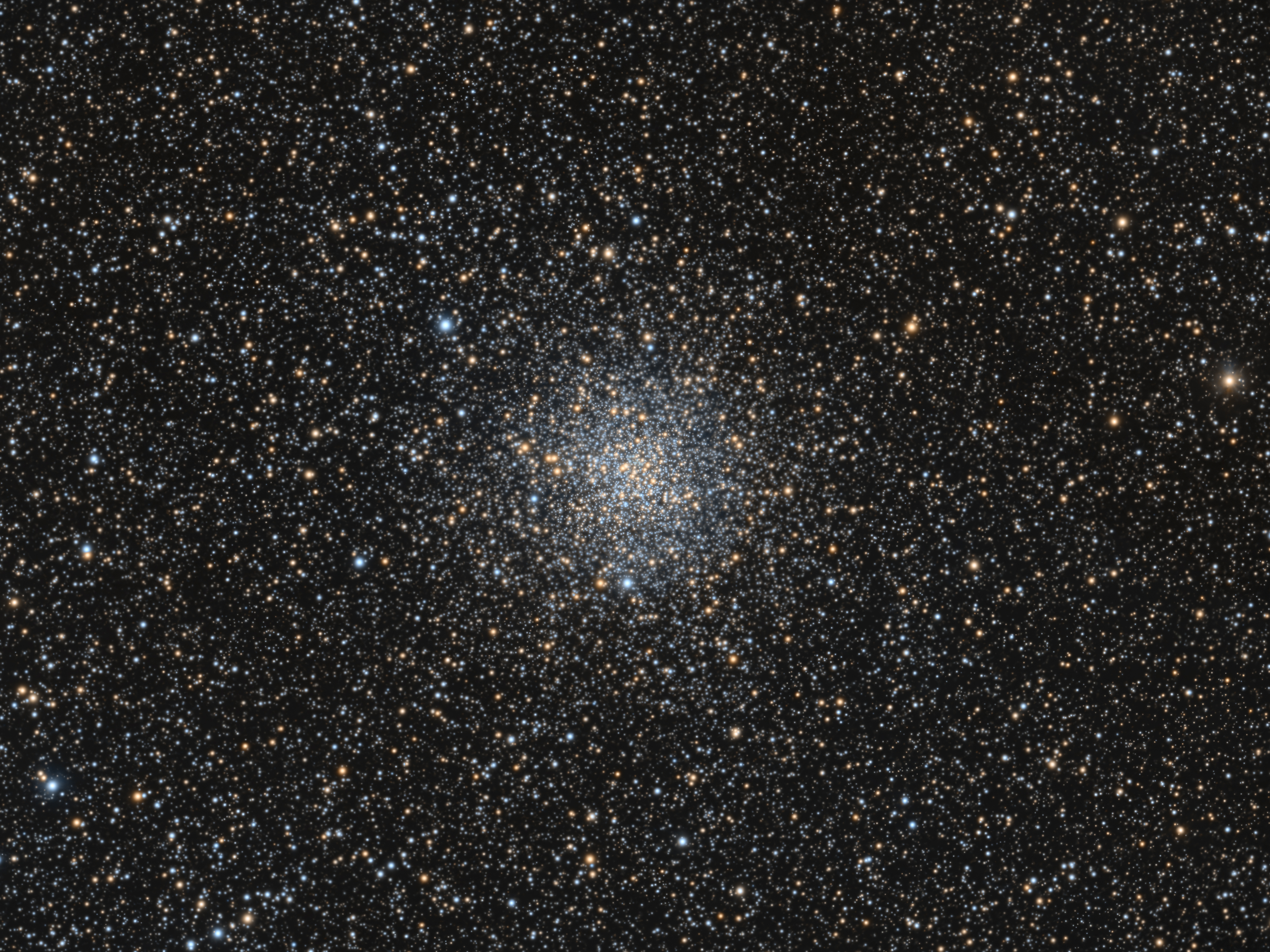
Messier 71 (M71, also known as NGC 6838, Cr 409, the Angelfish Cluster) is a globular cluster located about 12,000 light years away in the constellation Sagitta, the Arrow. It is about 27 light years across, and relatively young at around 9 or 10 billion years old. It has the mass of about 53,000 suns and the luminosity (basically, brightness) of around 19,000 suns. For a long time, M71 was misclassified as an open cluster.
Open clusters reside in the spiral arms of the Milky Way (and other galaxies) and are also sometimes called “galactic clusters.” They usually contain a few dozen to a couple thousand stars. In contrast, GCs contain hundreds of thousands to millions of stars, are usually quite densely packed, and form a halo around the Milky Way galaxy (other galaxies also have GCs). Globular clusters reside in a halo outside the main body of their host galaxy.
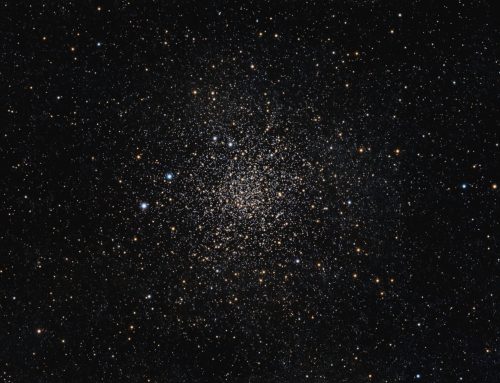
Although it is rather loosely packed, M71 looks clearly like a globular cluster through an eyepiece. However, images can make it look more like a rich open cluster (e.g. M11). Here’s another image in a wider field, taken in 2018.
M71 is set in a rich part of the summer Milky Way. I estimate that about 80,000-100,000 stars are visible and resolved in this image!
Tekkies:
Acquisition, focusing, and control of Paramount MX mount with N.I.N.A., TheSkyX. Primalucelab low-profile 2″ Essato focuser, ARCO rotator and Giotto flat panel. No guiding. Equipment control with PrimaLuce Labs Eagle 4 Pro computer. All pre-processing and processing in PixInsight. Acquired from my SkyShed in Guelph. Average transparency and above average seeing. Acquired under a nearly full Moon from May 29-31, 2026.
Celestron 14″ EDGE HD telescope at f/11 (3,931 mm focal length) and QHY600M-SBFL camera binned 2×2 with Optolong filters.
64 x 1m Red = 1hr 04m
65 x 1m Green = 1hr 05m
67 x 1m Blue = 1hr 07m
Total: 3hr 16m
 .
. Preprocessing: The WeightedBatchPreProcessing script was used to perform calibration, cosmetic correction, weighting, registration, and integration.
RGB and SynthL masters: A master RGB image was made from the Red, Green and Blue Drizzled masters using ChannelCombination in RGB mode. A synthetic luminance (SynthL) master was made from all four masters using ImageIntegration with weighting by SNR.
Gradient Removal: DynamicBackgroundExtraction was applied to the SynthL and RGBmasters.
Colour Calibration: BlurXterminator was applied to the RGB master with Correct Only selected, followed by ColorCalibration.
Deconvolution: BlurXterminator was applied to the RGB ane SynthL masters with Automatic psf, star sharpening set to 0.5, and non-stellar set to 0.9.
Stretching: MultiscaleAdaptiveStretch was applied to make a pleasing image from the RGB and SynthL masters. Approximate background level after stretch was 0.09 for the RGB master ane 0.1 for the SynthL master.
Nonlinear Processing
Combining Colour and Lightness: LRGBCombination was used to replace the L* channel of the RGB image with the SynthL.
Star Removal and processing: StarXterminator was used to remove the stars from the SynthLRGB master with Unscreen checked. Colour was increased in the stars-only image by increasing saturation using CurvesTransformation through a star mask.
Nonlinear Noise Reduction: NoiseXterminator was applied to the starless image with Amount=0.9 and Iterations=4.
Star Restoration: Stars were added back into the image using the PixelMath expression combine(starless, stars_only, op_screen())
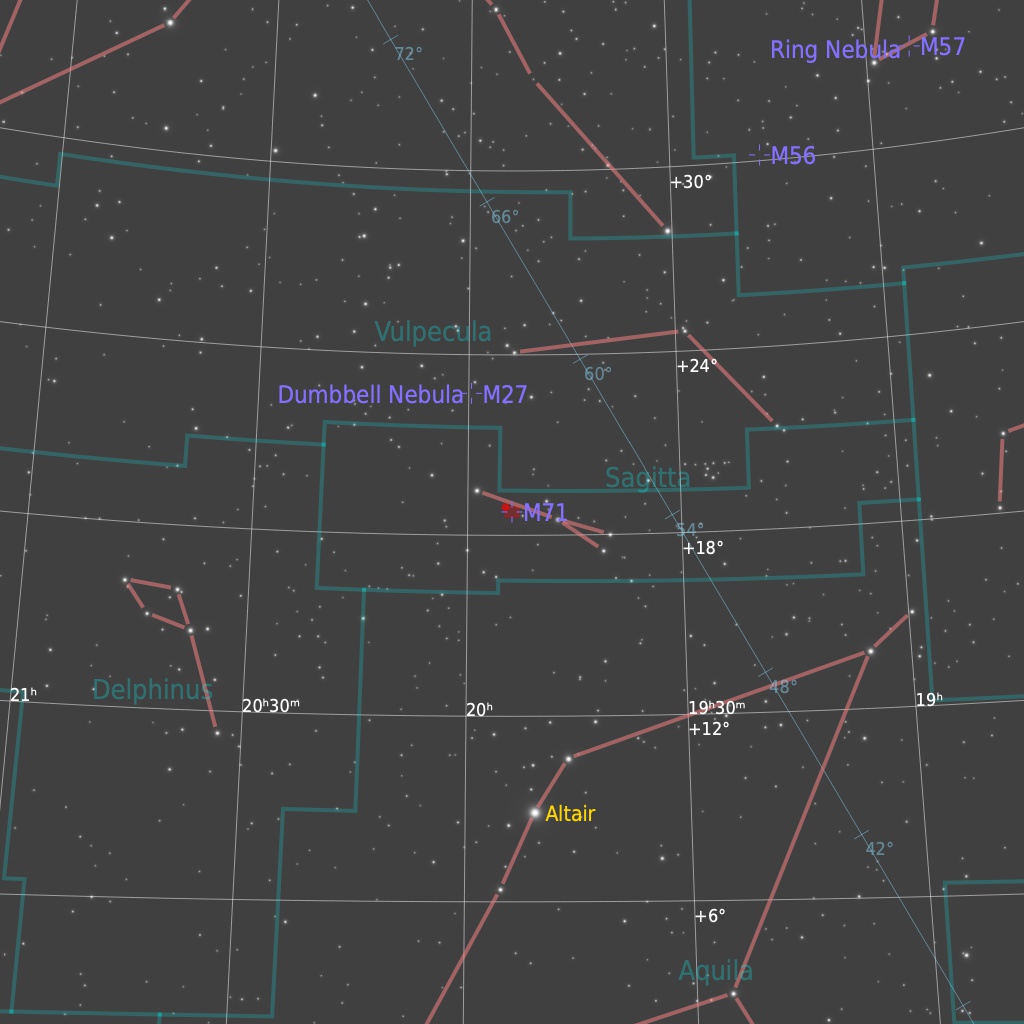
Final Steps: Brightness, contrast, and saturation were adjusted in several iterations using HistogramTransformation and CurvesTransformation with masks as required. ICCProfileTransformation (sRGB IEC61966-2.1; Relative Colorimetric with black point compensation) was applied prior to saving as a jpg. The finder chart was made using the FindingChart process.

Well done Ron! Really appreciate the write up as well, processing can be quite difficult (at least for me 😀).
Glad my notes are helpful.