
M81, Bode’s Galaxy
 Click image for full size version
Apil 5, 2026
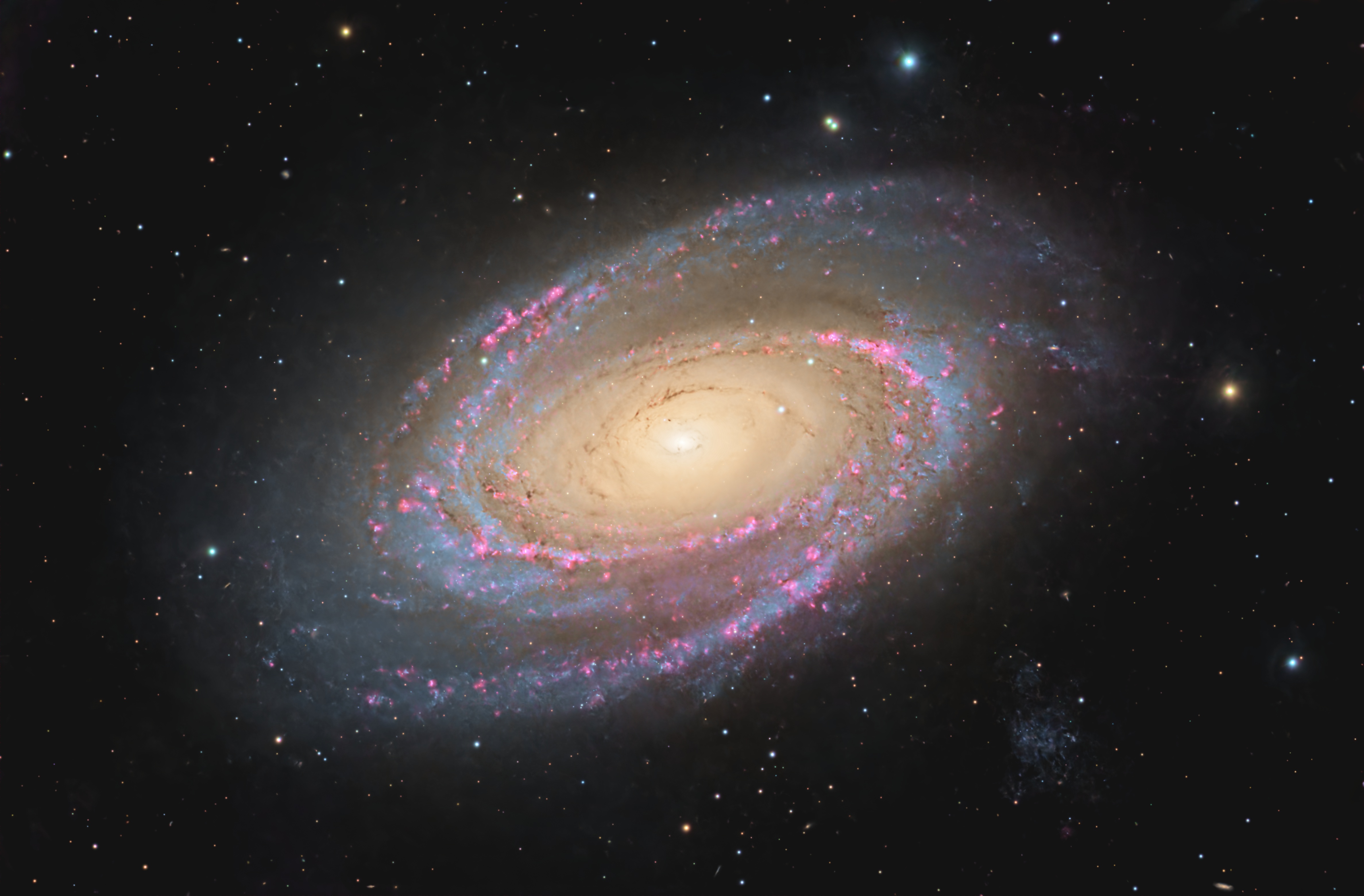
M81 is a large spiral galaxy in Ursa Major. It is also known as Bode’s Galaxy and NGC 3031. It’s about 12 million light years from us, and about a million light years away from M82, the Cigar Galaxy. They make a gorgeous pair in the eyepiece or in images. M81’s arms are loaded with pink nebulae, highlighted in this image using data collected with the hydrogen-alpha (Ha) filter. At the centre of M81 is a supermassive black hole with a mass equal to about 70 million times that of our Sun. This galaxy is about 96,000 light years across, similar to the Milky Way.
In the lower right of this image is irregular galaxy Holmberg IX (also UGC 5336). It is a satellite of M81, and resembles the Small Magellanic Cloud (one of the Milky Way’s satellite galaxies). It is one of the youngest nearby galaxies, with about 20% of its stars have formed in just the last 200 million years.
One of the interesting things about this image is just how little exposure time went into it. The telescope (a 14″ Celestron EDGE HD) is considered photographically ‘slow.’ And yet, the image reveals some stunning detail in spite of being just 3hr40m long. For many of my galaxy shots I capture 20 hours or more.
Tekkies:
Acquisition, focusing, and control of Paramount MX mount with N.I.N.A., TheSkyX. Guiding with PHD2. Primalucelab low-profile 2″ Essato focuser, ARCO rotator and Giotto flat panel. Equipment control with PrimaLuce Labs Eagle 4 Pro computer. All pre-processing and processing in PixInsight. Acquired from my SkyShed in Guelph. Average transparency and seeing. Acquired under a waxing crescent moon from March 24 and 27, 2026.
Celestron 14″ EDGE HD telescope at f/11 (3,931 mm focal length) and QHY600M-SBFL camera binned 2×2 with Optolong filters.
12 x 5m Red = 1hr 00m
13 x 5m Green = 1hr 05m
11 x 5m Blue = 0hr55m
8 x 5m Ha = 0hr 40m
Total: 3hr 40m
Preprocessing: The WeightedBatchPreProcessing script was used to perform calibration, cosmetic correction, weighting, registration, and integration.
RGB and SynthL masters: A master RGB image was made from the Red, Green and Blue Drizzled masters using ChannelCombination in RGB mode. A synthetic luminance (SynthL) master was made from all four masters using ImageIntegration with weighting by SNR.
Gradient Removal: DynamicBackgroundExtraction was applied to the SynthL, RGB and Ha masters.
Colour Calibration: BlurXterminator was applied to the RGB master with Correct Only selected, followed by ColorCalibration.
Deconvolution: BlurXterminator was applied to the RGB, SynthL, and Ha masters with Automatic psf , star sharpening set to 0.5, and non-stellar set to 0.9.
Linear Noise Reduction: NoiseXterminator was applied to the RGB, SynthL, and Ha masters with settings Amount=0.9 and Interations=4.
Ha Continuum Subtraction: The SpectrophotometricContinuumSubtraction script by Charles Hagan was used to remove continuum emissions from the Ha master using the red channel of the RGB master as the continuum reference image.
Stretching: MultiscaleAdaptiveStretch was applied to make a pleasing image from the RGB, SynthL and and Ha masters. Approximate background level after stretch was 0.09 for the RGB master, 0.1 for the SynthL master and 0.08 for the Ha master.
Nonlinear Processing
SynthL and RGB Combination: LRGBCombination was used to replace the CIE L* channel of the RGB image with the SynthL
Star Removal and processing: StarXterminator was used to remove the stars from the SynthLRGB master with Unscreen checked. Colour was increased in the stars-only image by increasing saturation using CurvesTransformation through a star mask.
Initial Saturation Boost: CurvesTransformation’s saturation tool was used to boost colour in the galaxy in the starless SynthLRGB image. A range mask made with RangeSelection was used to protect the background.
H-alpha Blending: The contiuum-subtracted Ha was added to the SynthLRGB image using Jurgen Terpe’s CombineHaWithRGB script.
Nonlinear Noise Reduction: NoiseXterminator was applied to the SynthLHaRGB image with settings Amount=0.9 and Iterations=5.
Contrast Enhancement: Jurgen Terpe’s MakeHDRImage was used to slightly compress the core of the galaxy. LocalHistogramEqualization was then applied twice. A Contrast Limit of 1.5 and 1 iteration was used for each application (scale 150, strength 0.35, and scale 40, strength 0.25).
Sharpening: MultiscaleMedianTransform was used to sharpen Layers 1 – 5 with strengths of 0.02, 0.02, 0.01, and 0.01, respectively.
Star Restoration: Stars were added back into the image using the PixelMath expression combine(starless, stars_only, op_screen())
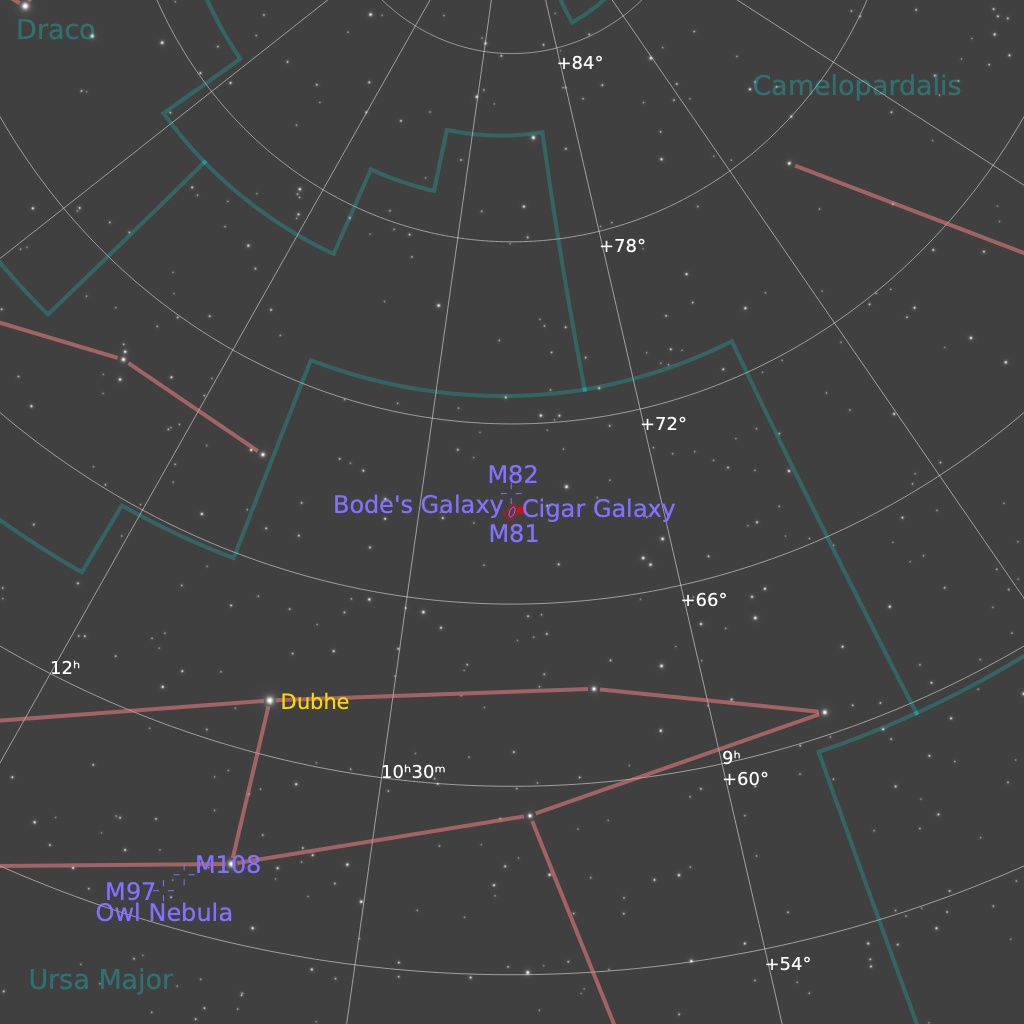
Final Steps: Background, galaxy, and star brightness, contrast, and saturation were adjusted in several iterations using CurvesTransformation and Jurgen Terpe’s SelectiveColorCorrection script with masks as required. ICCProfileTransformation (sRGB IEC61966-2.1; Relative Colorimetric with black point compensation) was applied prior to saving as a jpg. The finder chart was made using the FindingChart process.

Leave A Comment