
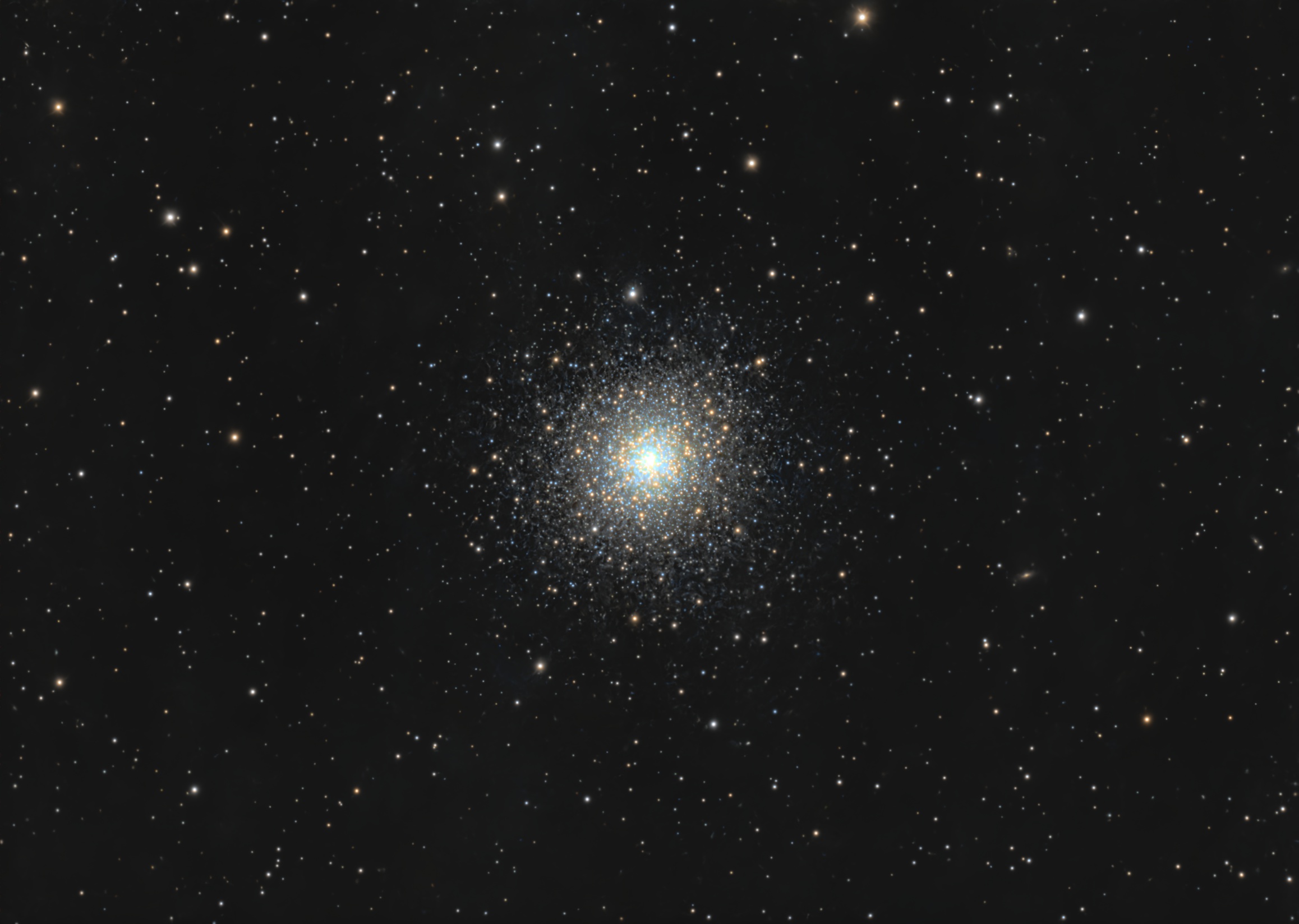
M92 with Celestron Origin
Click images for full size versions
August 30, 2026
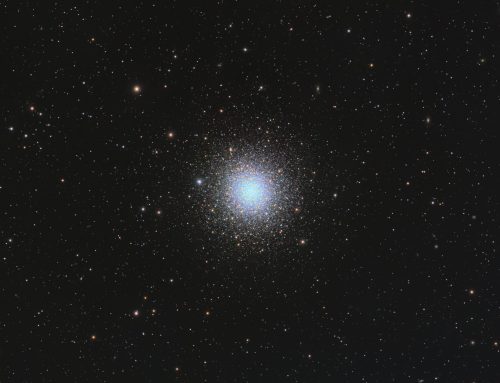
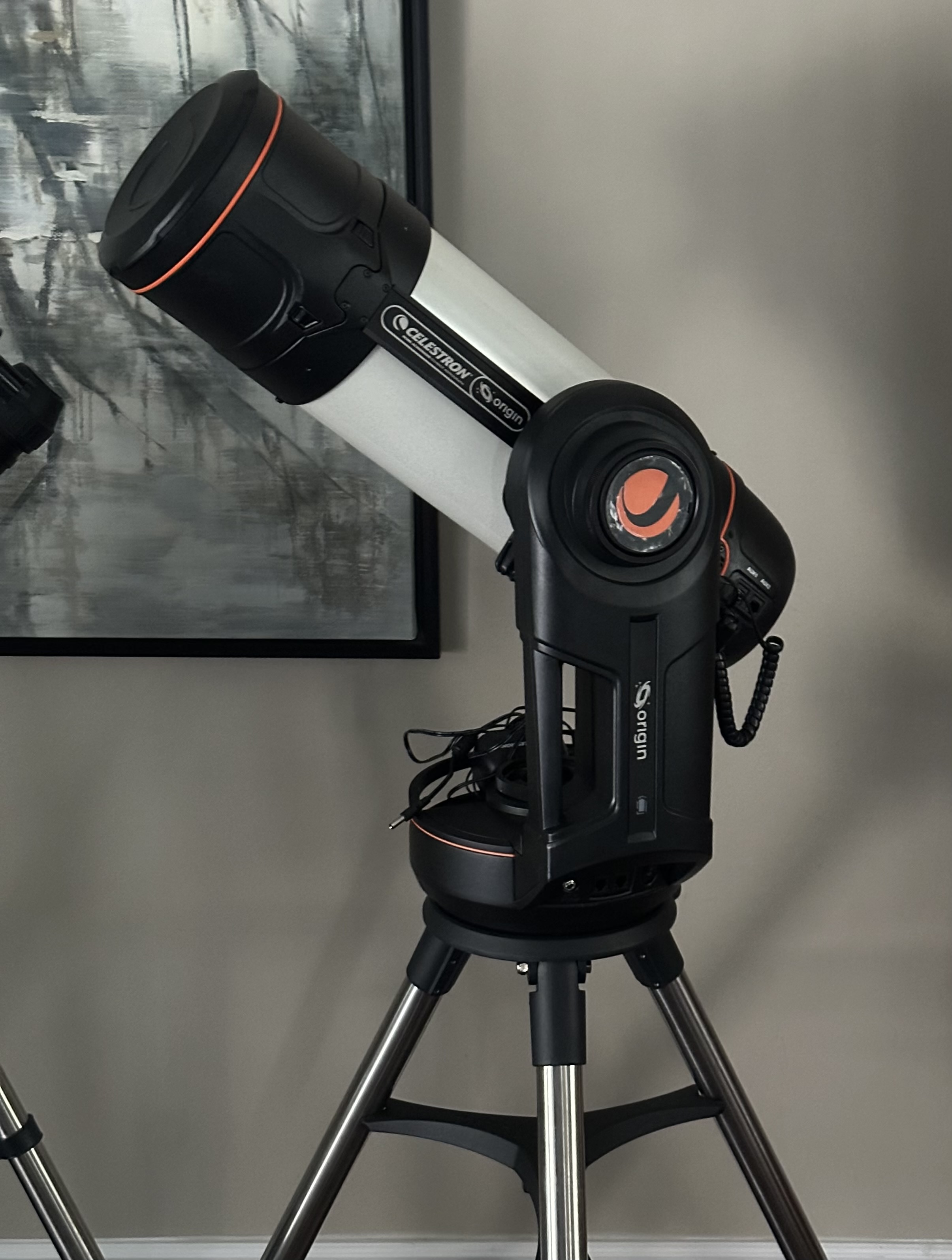 I’m continuing to test the Celestron Origin Mark II ‘Intelligent Home Observatory,’ which Celestron loaned me to use for a while. I had first light with it on August 17, and have used it on the rare clear nights since. This image was taken on the night of the full Moon (August 27) just before the eclipse began.
Tonight I was interested in looking at three things:
– battery powered operation,
– saving individual raw frames vs. Origin stacking them automatically, and
– file transfer over WiFi.
Here’s what I found:
Battery Power: After about 3 hours of use at 15C the app started showing the battery status as ‘low,’ but it was still running after 3hr 30m.
Automatic vs Manual Stacking: I compared the stacked image produced automatically by the Origin vs. calibrating and stacking the individual sub-frames amyself in PixInsight. The two approaches produced results that were indistinguishable. I will repeat this test a few times to confirm. If my results confirm this, then I may just save stacked (but unprocessed) masters rather than raw files. I can see the benefit of getting multiple automatically stacked images of the same object, and then using PixInsight to align and stack those master images. However, as noted below, Drizzle processing could improve detail markedly, particularly with hundreds of well-dithered sub-frames.
File Transfer: As for transferring files over WiFi, I used the free FileZilla app to transfer the image files from the Origin to my Mac for processing; USB file transfer also works well. Both types of file transfer (WiFi) are discussed in the detailed manual available online. The Quick Start manual describes the USB option, but not WiFi.
Other Impressions:
The Origin continues to impress me. It is very easy to use. The core of M92 burned out a bit with 10s exposures, which is due to the photographic speed (f/2.2) of the Origin. The image scale is 1.48″ per pixel. That is a bit undersampled and would benefit from Drizzle processing.
I will soon add the equatorial wedge and StarSense autoguider to the Origin and try an all-night exposure on a single faint target. The wedge, once properly aligned, will elminate the field rotation that limits me to about 40m right now.
Tekkies:
Acquisition, focusing, and preprocessing by Celestron Origin. 10-second unguided exposures acquired under good transparency and seeing in a moonless sky on August 17, 2026. All exposures were 10s. Total exposure times:
193 x 10s = 32m10s, automatically aligned and stacked by Origin
Image scale: 1.2 arcsec pwer pixel
Gradient Removal: DynamicBackgroundExtraction was applied to the RGB master.
Colour Calibration: ColorCalibration was applied to the RGB master.
Deconvolution: BlurXterminator was applied to the RGB master with Automatic psf , star sharpening set to 0.5, and non-stellar set to 0.9.
Linear Noise Reduction: NoiseXterminator was applied with settings Amount=0.9 and Iterations=4.
Stretching: MultiscaleAdaptiveStretch was applied to make a pleasing image with background brightness approximately 0.1.
Nonlinear Processing
Nonlinear Noise Reduction: NoiseXterminator was applied to the image with Amount=0.9 and Iterations = 4.
Re-stretch: HistogramTransformation was used to boost contrast in the image by moving the dark point to the toe of the histogram and slightly decreasing the mid-point slider.
Final Steps: Background, object, and star brightness and saturation were adjusted in several iterations using CurvesTransformation with masks as required. ICCProfileTransformation (sRGB IEC61966-2.1; Relative Colorimetric with black point compensation) was applied prior to saving as a jpg. The AnnotateImage script was used to create the annotated image and the FindingChart process was used to make the finder chart.

Leave A Comment