
Draco Triplet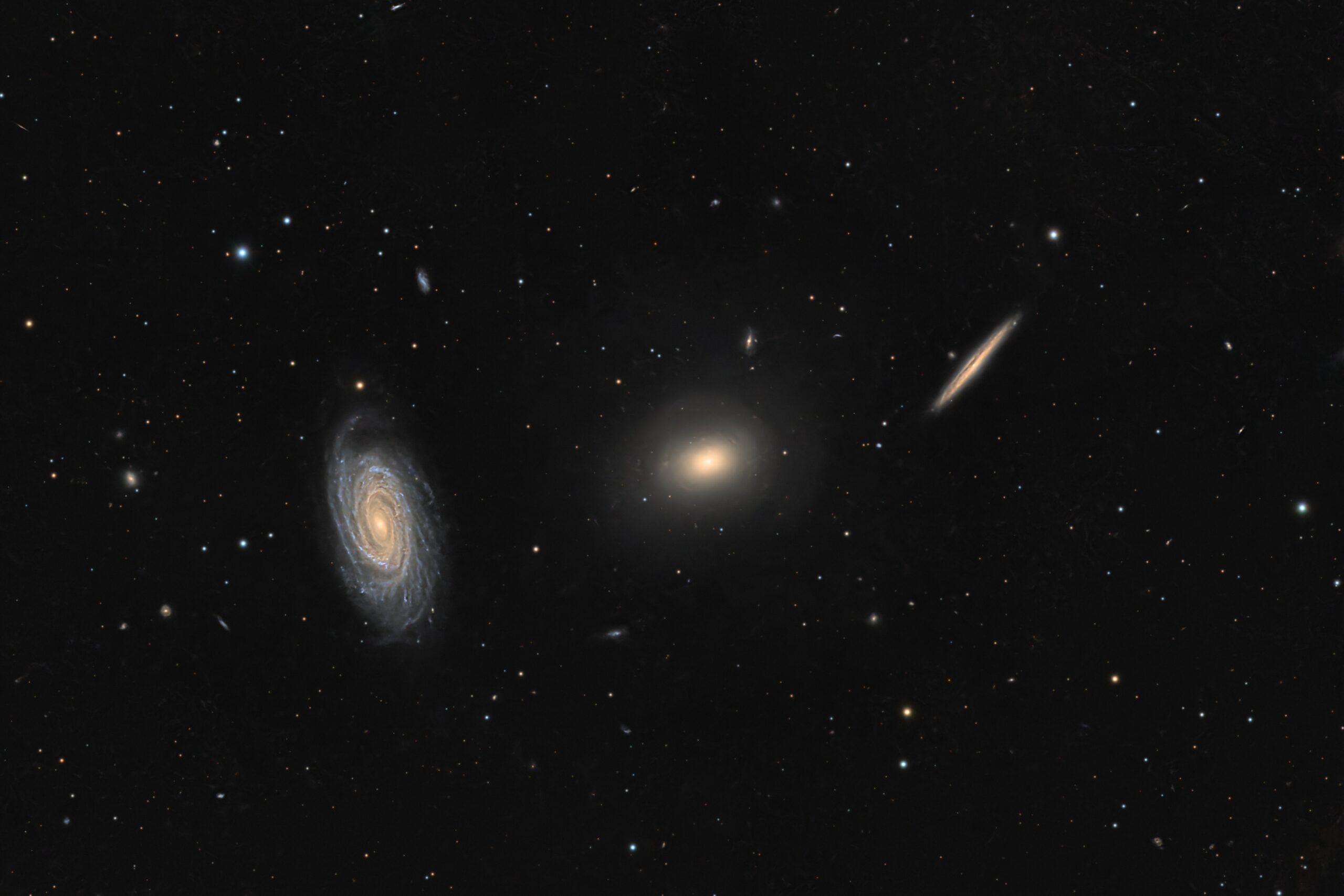
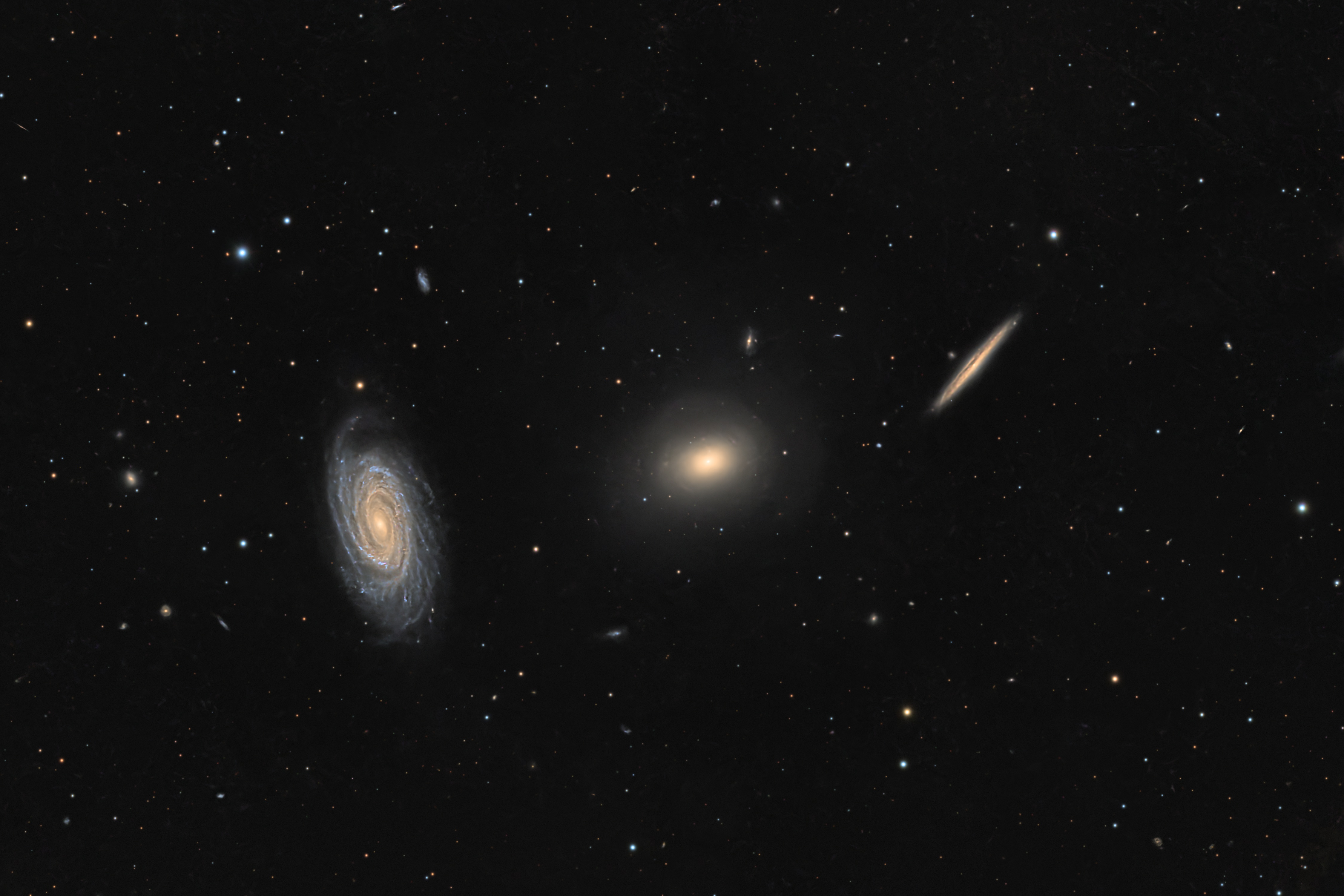
Click image for full size version
July 4, 2026
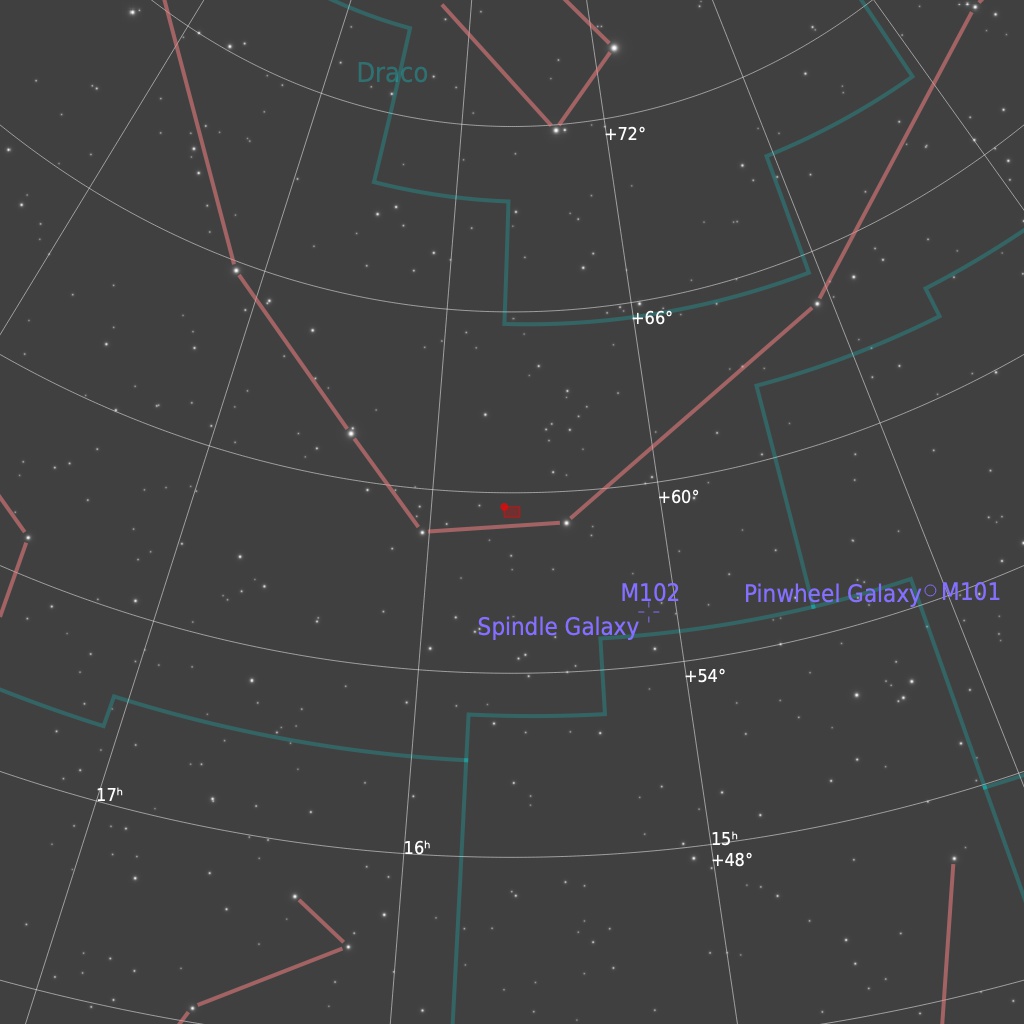
The three main galaxies in this image, from left to right, are NGC 5985, NGC 5982, and NGC 5981. They are at quite different distances, and appear close only due to being along the same line of sight. This field is located in the Draco constellation, the Dragon.
Farthest of the three, at 140 million light years, is NGC 5985, an active (Seyfert) spiral galaxy. It is about a third larger than our Milky Way and shows the most detail among the Triplet members.
NGC 5982 doesn’t show much detail, but does seem to exhibit some concentric shells, which could indicate a long-past merger with another galaxy. It is about 130 million light years away.
The nearest of the three Triplet members, NGC 5981, is another spiral galaxy, this time oriented edge-on from our line of sight. Its dark dust lanes are easily visible. It’s ‘only’ about 112 million light years from Earth.
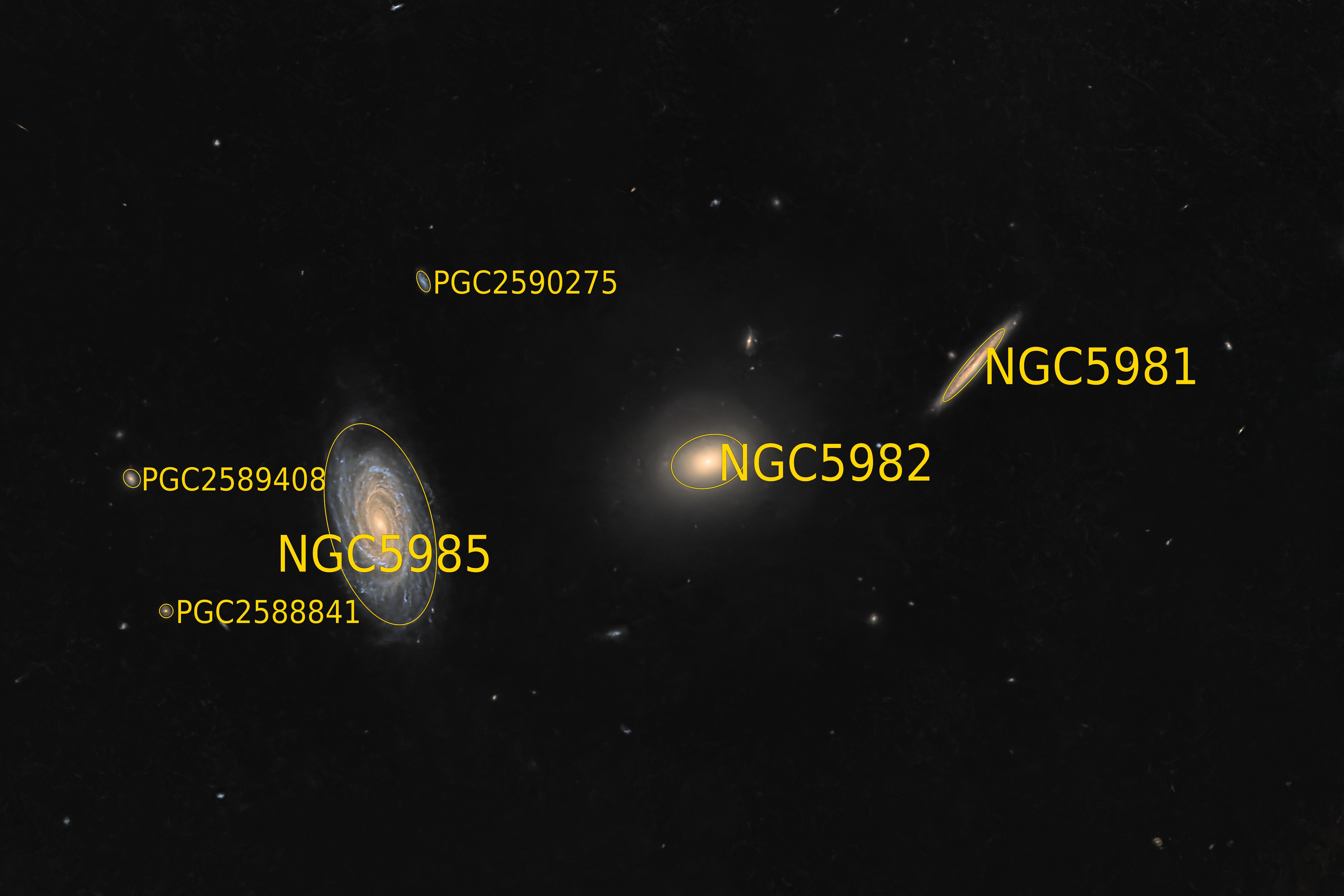
There are dozens of other galaxies in this image, all much farther away. This annotated version without stars, makes it easy to see the galaxies in the image. NGC, IC and PGC galaxies are marked and labelled. However, there are many more unlabelled galaxies that aren’t in these often-referenced galaxy catalogues.
Tekkies:
Acquisition, focusing, and control of Paramount MX mount with N.I.N.A., TheSkyX. No guiding. Primalucelab low-profile 2″ Essato focuser, ARCO rotator and Giotto flat panel. Equipment control with PrimaLuce Labs Eagle 4 Pro computer. Guided with OAG and PHD2. All pre-processing and processing in PixInsight. Acquired from my SkyShed in Guelph. Average transparency and average or better seeing. Acquired under little or no moon illumination from June 7-20, 2026.
Celestron 14″ EDGE HD telescope at f/11 (3,931 mm focal length) and QHY600M-SBFL camera binned 2×2 with Optolong filters.
57 x 5m Red = 4hr 45m
55 x 5m Green = 4hr 35m
57 x 5m Blue = 4hr45m
Total: 14hr 05m
 .
. 
Preprocessing: The WeightedBatchPreProcessing script was used to perform calibration, cosmetic correction, weighting, registration, integration, and drizzle integration.
RGB and SynthL masters: A master RGB image was made from the Red, Green and Blue Drizzled masters using ChannelCombination in RGB mode. A synthetic luminance (SynthL) master was made from all three masters using ImageIntegration with weighting by SNR.
Gradient Removal: DynamicBackgroundExtraction was applied to the SynthL and RGB masters.
Colour Calibration: BlurXterminator was applied to the RGB master with Correct Only selected, followed by SpectrophotometricColorCalibration.
Deconvolution: BlurXterminator was applied to the RGB and SynthL masters with Automatic psf, star sharpening set to 0.5, and non-stellar set to 0.9.
Stretching: MultiscaleAdaptiveStretch was applied to make a pleasing image from the RGB and SynthL masters. Approximate background level after stretch was 0.09 for the RGB master and 0.1 for the SynthL master.
Nonlinear Processing
SynthL and RGB Combination: LRGBCombination was used to replace the CIE L* channel of the RGB image with the SynthL
Star Removal and processing: StarXterminator was used to remove the stars from the SynthLRGB master with Unscreen checked. Colour was increased in the stars-only image by increasing saturation using CurvesTransformation through a star mask.
Nonlinear Noise Reduction: NoiseXterminator was applied to the SynthLRGB image with settings Amount=0.9 and Iterations=5.
Secondary Stretch: HistogramTransformstion was used to darken the background while maintaining brightness in the galaxies.
Contrast Enhancement: LocalHistogramEqualization was then applied twice. A Contrast Limit of 1.5 and 1 iteration was used for each application (scale 100, strength 0.25 and scale 32, strength 0.2).
Star Restoration: Stars were added back into the image using the PixelMath expression combine(starless, stars_only, op_screen()) and then reduced using Mike Cranfield’s and Bill Blanshen’s StarReduction script.
Final Steps: Background, galaxy, and star brightness, contrast, and saturation were adjusted in several iterations using CurvesTransformation with masks as required. ICCProfileTransformation (sRGB IEC61966-2.1; Relative Colorimetric with black point compensation) was applied prior to saving as a jpg. The finder chart was made using the FindingChart process. The annotated image was made with the AnnotateImage script.

Leave A Comment